
Newton’s first law
An ice hockey player sends a puck across freshly resurfaced ice. The puck slides, crosses almost the whole rink and slows down only a little on the way, even though nobody is pushing it any more. If the ice were perfectly smooth and the rink endless, the puck would go on for ever at the same speed and in the same straight line. That is the essence of Newton’s first law, also called the law of inertia.
The law of inertia
Isaac Newton formulated it in 1687 roughly like this:
Every body perseveres in its state of rest, or of uniform motion in a right line, unless it is compelled to change that state by forces impressed thereon.
This does not mean that no force may act on the body. It is enough for the resultant of all the forces acting on it to be zero. The Earth pulls the puck down and the ice pushes it up with an equal force. Friction on ice is so tiny that we hardly notice it. The forces are practically balanced and the puck behaves as if nothing were acting on it. Written briefly:
If the resultant force
The reverse is true as well: when a body is at rest or moves at a constant velocity in a straight line, the resultant force on it is zero. And when the velocity of a body changes, whether in magnitude or in direction, the resultant force is not zero.
The ability of a body to keep its velocity is called inertia. Every body has it: a stone, a puck, a bus and you.
So why do things stop?
Everyday experience, though, says the opposite. If you stop pedalling, the bike stops after a while. A ball rolling on grass stops too. The Greek philosopher Aristotle taught in the 4th century BC that the natural state of earthly bodies is rest. For something to move, something has to keep pushing it, and as soon as the pushing ceases, the body stops by itself. It sounds reasonable and people believed it for almost two thousand years. If you thought so too, you are in good company. In reality it is different.
Galileo Galilei solved this in the 17th century with a thought experiment with two slopes.
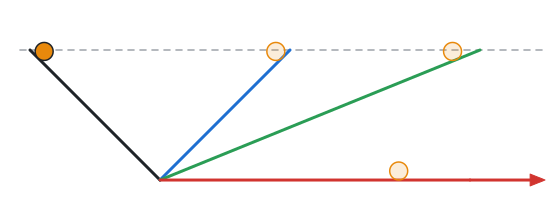
A ball released from the left slope rolls down and on the opposite slope climbs to the height it started from, marked by the grey dashed line. There it stops for a moment. The gentler the right-hand slope is, the further the ball travels before it climbs to that height. On the blue steep slope it is only a short distance, on the green gentle one much further and longer. And what if the right-hand slope does not rise at all, like the red horizontal track? Then the ball never reaches the starting height, and so it keeps rolling at the same speed until it rolls out of the picture.
A real ball climbs only almost to the starting height and eventually stops on the horizontal track. It is slowed down by friction and air resistance, forces that act against the motion. They are what stops the bike and the ball on the grass. A body never stops on its own; some force always slows it down. On ice friction is small, which is why the puck goes so far.
Another popular misconception goes with this. When you throw a ball, it is easy to say that it flies on because the force from your hand stays in it, and that this force “runs out” on the way. There is no such force in the ball. The hand acts on the ball only until you let go. After that only the Earth and air resistance act on it, and nothing drives it forwards. It flies forwards thanks to inertia. A force is needed to change the velocity, not to keep something moving.
A bus pulls away
You are standing in a bus, not holding on, and the bus pulls away sharply. You are jerked backwards. It looks as if something were pulling you back, but nothing acts on you backwards. The floor has started moving and carried your feet with it, because your shoes grip it. Nothing forces the rest of your body to change its motion, so according to the law of inertia it stays at rest relative to the road. Your feet move forwards, your body stays behind and you lean back.
Once the bus settles to a steady speed on a straight road, you can stand in it calmly without holding on. Your velocity is the same as the bus’s and nothing needs to change it.
For the same reason, in a car that accelerates sharply, the seat pushes you in the back. That push is the force that sets you moving together with the car. Without it you would stay where you were and the car would drive off without you.
A bus brakes
Braking is the exact opposite. The bus slows down, but you carry on at the same velocity until something stops you. Relative to the bus you therefore slide forwards.
How much time do you have? A coach brakes hard with a deceleration of
We will calculate in the frame of reference attached to the road. At the moment the driver steps on the brake, the coach and the passenger are travelling at the same velocity v0. The passenger carries on at a constant velocity and in time t covers
The coach brakes; this is uniformly accelerated motion with negative acceleration, and it covers less:
The difference of the distances tells us how far the passenger has moved relative to the coach. We denote it x:
The initial velocity has cancelled out, so it doesn’t matter at all how fast the coach was travelling. We express the time:
Substituting:
In that time the coach slows down by
That is why coaches have seat belts.
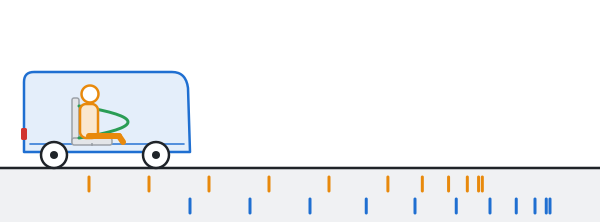
The coach is moving to the right and from the moment the red brake light comes on, it slows down. Marks are added under the road after equal intervals of time: the orange ones show where the passenger was, the blue ones where the front of the coach was. The orange marks are at first equally spaced, because the passenger does not slow down. The spacing of the blue marks gets shorter during the braking. The passenger therefore moves forwards relative to the coach until they are held by the green belt. Only then does the belt slow them down, and from there they travel together with the coach. In the animation the belt is very slack so that the displacement is easy to see.
A tablecloth pulled from under the dishes
A familiar trick: the table is laid, the magician jerks the tablecloth sharply and the dishes stay standing on the bare tabletop. Only the friction between the cloth and the plate could take the plates with it. If you pull sharply enough, it acts for only a fraction of a second and in such a short time it hardly sets the plate moving. Inertia keeps it in place. Someone who pulls slowly gives friction enough time and the dishes slide off with the cloth onto the floor.
Try it, but preferably not with your grandma’s china. Put a postcard on a glass and a coin on top of it. Then flick the postcard sharply, horizontally. The postcard flies away and the coin drops into the glass with a clink.
Seat belts and head restraints
In a car the same thing applies as in a braking coach, only everything is much more violent. When a car hits an obstacle, it stops in roughly a tenth of a second. But a driver without a seat belt carries on at the velocity the car had before the impact, and is stopped only by the steering wheel or the windscreen. A seat belt holds them to the seat so that they stop together with the car, and it spreads the force that stops them over the chest and pelvis.
A head restraint protects you in a rear-end collision. Imagine another car runs into yours while it is standing still: your car and the seat shoot forwards and the seat takes your body with it. Nothing pushes your head, so it stays where it was. Your body moves away from it and your neck is sharply bent backwards. The head restraint pushes the head forwards together with the body. That is why it should be adjusted high enough to be behind your head, not behind your neck.
An inertial frame of reference
Let’s look at a passenger without a seat belt through the eyes of the person sitting next to them. As long as the coach is moving at a constant speed, the passenger is at rest relative to them. As soon as the coach starts to brake, the passenger sets off forwards relative to the coach, with uniform acceleration,
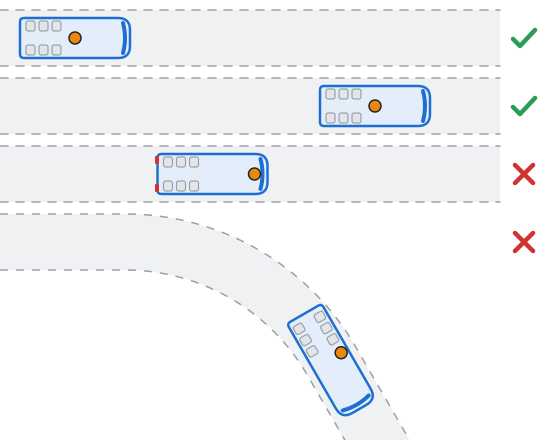
A test shows whether the law of inertia holds. Put a ball on the floor of the coach and don’t touch it. If it stays where it is, the law holds in the coach. If it starts rolling by itself, it doesn’t hold, because nothing is pushing it horizontally. From the road you can see why: the ball keeps its velocity, and it is the coach under it that slows down or turns.
A frame of reference in which the law of inertia holds is called an inertial frame of reference, from the Latin inertia, meaning inactivity or sluggishness.
| bus | ball | inertial? |
|---|---|---|
| stationary | stays at rest | yes |
| moves in a straight line at a constant speed | stays at rest | yes |
| brakes | rolls forwards | no |
| turns | rolls sideways | no |
The first two buses look exactly the same from the inside. That is why, on a train running smoothly along a straight track, you cannot tell with your eyes closed whether it is moving or standing still. Any vehicle that moves in a straight line at a constant speed relative to the road is therefore inertial: a ball lies still in it.
Not even the road is exactly inertial: the Earth rotates and goes round the Sun. But the acceleration due to the rotation is at most about 0.034 m/s2, and so we will treat the Earth as inertial.
The law of inertia says what a body does when the resultant force on it is zero. What happens when it is not zero, and why a heavier body is harder to set in motion, is explained in the next article, Newton’s second law.
