
Centripetal force
Simon whirls a stone on a string above his head. The stone goes round, the string is taut, and Simon can feel the stone tugging at his hand. But as soon as he lets go of the string, the stone flies off. Turning simply doesn’t come for free: if you want a body to move in a circle, you have to force it to, with a force that points towards the centre. That force is called the centripetal force.
If all you want is the formula: a body of mass m moving at speed v in a circle of radius r must have a centripetal force acting on it of
where ω is the angular velocity.
A force that turns the velocity
In uniform circular motion the speed stays the same, but the velocity arrow keeps turning. The body therefore has a centripetal acceleration, which points towards the centre of the circle and has magnitude
By Newton’s second law, every acceleration comes from a resultant force, F = m · a, and the resultant force points where the acceleration points. So a body on a circle must have a resultant force acting towards the centre. We replace the acceleration by the centripetal acceleration:
If we substitute the second form of the acceleration, we get Fc = m · ω2 · r. We haven’t invented anything new: this is just Newton’s second law applied to turning. The units agree:
According to the formula, turning is harder the greater the mass of the body, the faster it goes and the sharper the bend. The speed is squared, so at double the speed we need four times the force.
Centripetal force is not a new force
This is where mistakes are often made. Centripetal force is not another kind of force to stand beside weight, friction or the tension in a string. It is a role that some perfectly ordinary real force, or the resultant of several forces, plays in a given situation:
- the stone is held on its circle by the tension in the taut string,
- a car on a bend is turned by the friction between the tyres and the road,
- the Moon orbits the Earth thanks to the gravity with which the Earth attracts it.
When you draw the forces acting on a body, draw only the real ones. An extra arrow labelled “centripetal force” beside the string is a mistake, because the force of the string would then appear twice in the diagram. The formula
A stone on a string
Simon’s stone has a mass of 0.2 kg, the string is 1 m long, and the stone goes round twice a second, so the period is 0.5 s. How hard must the string pull on the stone?
The angular velocity is one revolution, 2π radians, per period:
We substitute into the second form of the formula. The radian is a pure number, and so the result comes out in newtons:
The string pulls on the stone with a force of about 32 N, as if a 3 kg bag were hanging from it. If Simon whirled the stone twice as fast, the string would have to withstand four times as much, about 126 N. The weight of the stone is only about 2 N, which is why we ignored it. By Newton’s third law, the stone pulls back on the string with an equally large force, and the string passes it on to Simon’s hand. That pull is exactly what Simon feels.
When the string breaks
What happens as soon as the string snaps? The animation shows the answer. As long as the string holds, it pulls the stone towards the centre with the green force and the red velocity arrow keeps turning. At the moment the string breaks, the force vanishes. In the horizontal direction nothing acts on the stone any more, so by the law of inertia it flies in a straight line, at the same speed and in the direction its velocity pointed at the moment of the break. That is along the tangent to the circle.
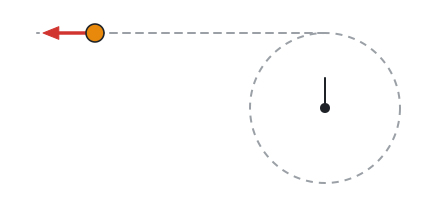
So the stone does not fly “outwards” along a line from the centre, as it might seem. Nothing pulls it outwards, it has simply stopped turning. A sling makes use of this: the stone is released exactly when its velocity points at the target. Simon’s stone leaves at a speed of ω · r ≈ 12.6 m/s, which is about 45 km/h, so the neighbours’ window is in danger.
A car on a bend
A car of mass 1,200 kg takes a bend of radius 50 m at a speed of 54 km/h. We convert the speed, 54 km/h = 15 m/s, and substitute:
Where does this 5,400 N come from? There is no string on the road. The only thing that makes the car turn is the friction between the tyres and the tarmac, which points towards the centre of the bend.
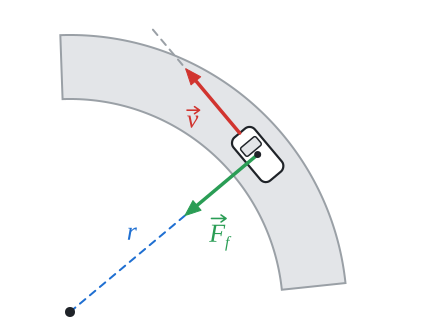
The tyre does not slide sideways along the road, though. The spot where it touches the tarmac is at that moment not moving relative to the road, and so this is static friction. It is exactly as large as is needed, here 5,400 N, but only up to its maximum.
Will any road do? We shall use the coefficients of kinetic friction. The static friction of tyres is usually somewhat greater, so the results are a cautious estimate. For rubber on dry tarmac the coefficient is about 0.7, on wet tarmac 0.5, on snow 0.3 and on ice 0.1. The weight of the car is 1,200 kg · 9.81 m/s2 = 11,772 N, and on a horizontal road the normal force is equally large. Friction must supply 5,400 N, so the coefficient of friction must be at least
How fast can you take a bend?
On a horizontal road the normal force balances the weight, FN = m · g, and the greatest frictional force is μ · m · g. The car gets round the bend as long as the friction is enough:
The greatest speed is the one at which equality holds. The mass cancels, we multiply both sides by the radius and take the square root:
On dry tarmac, μ = 0.7:
On a dry road, then, a car can take the bend at about 67 km/h at most, so it manages our 54 km/h with room to spare. On ice, μ = 0.1:
On icy ground you can enter the same bend only a little faster than a cyclist rides. Because the mass cancels, this holds equally for a small car and a loaded lorry with the same tyres. A car with a greater mass needs a greater force, but it also presses harder on the road, and so it has greater friction too.
What if the car enters the bend faster? The friction reaches its maximum and cannot give more. The force towards the centre is smaller than a circle of radius 50 m would need, so the car turns less. It follows a gentler arc, in the extreme case almost straight along the tangent, and the bend slips away from under its wheels. To an observer by the roadside it looks as if the car has been “carried outwards”. In reality nothing pushed it outwards, friction simply could not turn it enough.
The formula can also be used the other way round. How wide a bend does a road need for it to be taken at 130 km/h, which is about 36.1 m/s? We divide the equation v2 = μ · g · r by the product μ · g:
On a wet road with a coefficient of 0.5, about 266 m is already needed, and even that is still without any margin. Bends on fast roads therefore usually have a radius of many hundreds of metres and are also banked.
Banked curves
On motorway slip roads, in a velodrome and on a bobsleigh track the bend is tilted: the outer edge lies higher than the inner one. The normal force is perpendicular to the road, so it no longer points vertically up, but at an angle towards the centre of the bend.
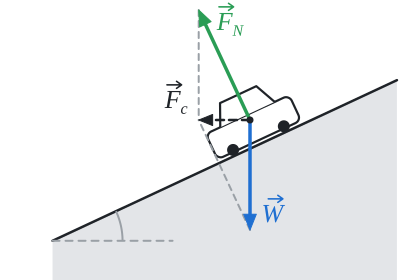
The weight and the normal force then do not cancel, and part of the job that friction does on a flat road is taken over by the normal force. At a suitable speed their resultant points exactly horizontally towards the centre and provides the whole centripetal force, so the car would get round the bend even without friction, for example on ice. In the figure both forces are drawn from a common point so that their sum can be constructed with a parallelogram. The more steeply the bend is banked, the faster it can be taken. This is why cyclists in a velodrome ride round bends banked as steeply as a roof.
What holds the Moon
The Moon orbits the Earth at a distance of about 3.84 · 108 m, and one orbit takes it 27.3 days, which is about 2.36 · 106 s. Its speed is
The mass of the Moon is about 7.35 · 1022 kg. The centripetal force with which the Earth must hold it comes out as
No rope could withstand such a force. But the Moon needs no rope, because gravity plays that role. If the Earth stopped attracting the Moon, it would fly off along the tangent just like Simon’s stone.
Calculator for the greatest speed on a bend
Enter the radius of the bend and choose the surface. The calculator works out the greatest speed
So far we have described everything from the roadside, where it is clear that the car and the stone are simply made to turn by a force towards the centre. A passenger in the car experiences it differently, though: they are pressed against the door, and from their point of view it looks as if something is pushing them towards it. Fictitious forces show how the motion can be described from the point of view of someone riding along in the car.
How a passenger inside the car experiences a bend, and why it seems that something is pushing them outwards, is explained in the next article, Fictitious forces.
