
Newton’s third law
The skater Amelia stands on the ice facing the boards, puts her palms against them and pushes off. She glides backwards, away from the boards. Nobody pushed her, she did the pushing, and she pushed the boards, not herself. But an object does not start moving by itself, something has to exert a force on it. So who pushed Amelia? The boards.
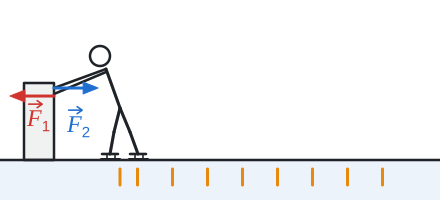
The grey figure is Amelia at the moment she pushes off. Amelia pushes on the boards with her palms with the red force
The law of action and reaction
Isaac Newton wrote it down in 1687 in the Principia as follows (translated from the Latin):
To every action there is always opposed an equal reaction: or the mutual actions of two bodies upon each other are always equal, and directed to contrary parts.
In today’s words: if one object exerts a force on another, the second object exerts a force of the same size and opposite direction on the first:
The minus sign in front of the vector says that the direction is opposite, while the magnitudes are the same, F2 = F1. One force is called the action and the other the reaction, and it does not matter which is which. Both appear and disappear at the same instant, neither comes first. A force is always an interaction between two objects, which is why forces always come in pairs. A lone force without its partner does not exist.
An action–reaction pair has three properties:
- the two forces are equal in magnitude,
- they have opposite directions,
- each acts on a different object.
The third property is the most important, and it is the one people most often get wrong. Amelia pushes on the boards, the boards push on Amelia. Only the force from the boards affects Amelia’s motion, because of the two forces only that one acts on her.
Let’s work it out. Amelia has a mass of 40 kg and the boards push on her with a force of 80 N. From Newton’s second law we get the acceleration:
If the push lasts half a second, Amelia moves away at a speed of 2 m/s2 · 0.5 s = 1 m/s.
And why did the boards not start moving? Amelia pushes on them with the same force, 80 N. But the boards are firmly attached to the arena, and that to the Earth, so the force is received by the whole Earth, with a mass of about 6 · 1024 kg:
Nobody will ever measure an acceleration like that. The forces are equal, but their effects are not, because they act on objects with very different masses.
The same thing happens when a fly hits the windscreen of a moving car. You would think the car hit the fly with a much greater force than the fly hit the car. But the forces are equal: the fly pushes on the glass with the same force as the glass pushes on the fly. The fly, however, has a mass of a fraction of a gram, so the same force gives it an enormous acceleration, which it does not survive. A car with a mass of a tonne or more is slowed by the same force so slightly that the driver does not notice.
The horse and cart paradox
A horse pulls a cart. By the third law, though, the cart pulls back on the horse with a force of the same size. The forces are equal and opposite, so they cancel and nothing should move. How is it that the horse and cart start moving anyway?
A common answer is that the horse pulls the cart harder than the cart pulls the horse. But that is not so; the two forces are equal at every moment, when setting off, when moving and when stopping. The mistake is in the word “cancel”. Only forces acting on the same object can add up and cancel. The horse’s force acts on the cart, the cart’s force acts on the horse. Each belongs to a different object, so they have no way of cancelling.
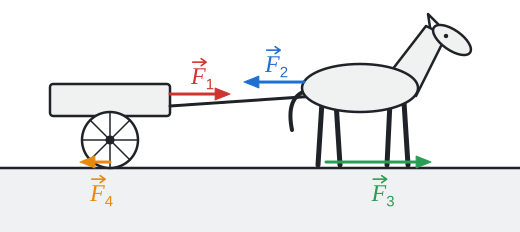
If we want to know whether the cart will start moving, we look only at the forces acting on the cart. The horse pulls it forwards with the red force
Two horizontal forces act on the horse. The cart pulls it backwards with the force
Now with numbers. The cart has a mass of 400 kg, the horse 600 kg. The horse pulls the cart with a force of 400 N and the resistance is 200 N. The resultant force on the cart is 400 N − 200 N = 200 N and the acceleration of the cart is
The horse must accelerate at the same rate, otherwise the cart would either run away from it or fall behind. So the resultant force on the horse must be 600 kg · 0.5 m/s2 = 300 N. The cart pulls it backwards with a force of 400 N, so the ground must push it forwards with a force of 400 N + 300 N = 700 N.
So it is the ground that sets the whole team in motion. It pushes the horse, and the horse pulls the cart. On an icy surface, where the hooves have nothing to grip, the horse would just scrabble and the cart would not move at all.
Walking, cars and swimming
We walk in exactly the same way. With each step, your foot pushes the ground backwards and the ground pushes you forwards. Only the force from the ground moves you forwards; your legs alone would not get you anywhere. On ice your foot slides over the ground and cannot push it backwards, which is why walking there is so difficult. The Earth receives an equally large backward force from you, but it is so massive that you cannot move it. It is similar when you jump. Your legs push the ground downwards and the ground pushes you upwards, and as long as the ground pushes you harder than the Earth pulls you down, you accelerate upwards. As soon as you leave the ground, the force from the ground disappears and only the weight is left, which brings you back down.
A car behaves in a similar way. The engine turns the wheels and the tyres push the road backwards. By the third law, the road pushes the car forwards. So the force we call the driving force is in fact exerted on the car by the road, and the engine only turns the wheels. That is why a car with spinning wheels on ice hardly moves off, even when the engine is roaring at full power.
A swimmer does the same with the water. They push the water backwards with their arms and legs and the water pushes them forwards. The oars of a rowing boat also push the water backwards, and the propeller of an aeroplane pushes the air.
The rocket
With a rocket it seems that there is nothing to push against. In space there is no ground, water or air. But the rocket carries with it what it pushes against. The engine burns fuel and expels the resulting hot gases backwards through the nozzle at high speed. The rocket pushes the gases backwards, the gases push the rocket forwards.
A widespread misconception says that a rocket pushes against the air behind it. It does not; the surrounding air rather gets in its way, so a rocket engine actually produces slightly more thrust in a vacuum than at ground level. A balloon that you inflate and let go of flies on the same principle. The air escapes from it backwards and the balloon flies forwards. Firefighters holding a hose feel the same thing. The nozzle sprays water forwards, the water pushes the nozzle backwards, and so they have to brace themselves firmly.
A book on a table
A dictionary with a mass of 2 kg lies on a table. The Earth pulls it down with a force, its weight, of
But the dictionary does not fall, so another force must be acting on it, upwards. It is the force with which the tabletop pushes the dictionary from below. It is called the normal (contact) force
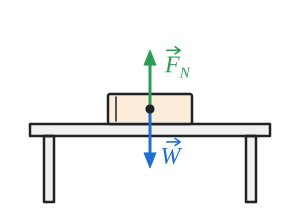
The blue weight and the green normal force are equal in size and opposite. Is this an action–reaction pair? It is not. Both act on the same object, the dictionary, whereas action and reaction always act on two different objects. The weight and the normal force are two different forces in balance. The fact that they are equal follows from the law of inertia, not from the law of action and reaction.
So where are the reactions? Each of the two forces has its own:
- the table pushes the dictionary upwards with the normal force
- the Earth pulls the dictionary downwards with the weight
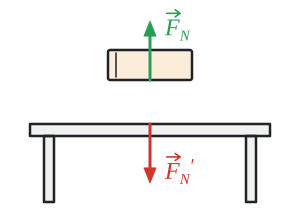
The dictionary is lifted slightly in the picture so that you can see which force acts on which object. The green normal force acts on the dictionary, the red force
The difference is easy to see if you press down on the dictionary from above with your palm, with a force of 10 N. The weight does not change, the Earth pulls the dictionary just as before. But the table now holds up the dictionary against both the weight and your palm, and the normal force increases:
The reaction increases in the same way, and the dictionary pushes on the table with a force of 29.6 N too. So the weight and the normal force were equal only because nothing else was pushing on the dictionary, whereas action and reaction are always equal.
The best way to recognise an action–reaction pair is by the sentence that describes it. “The table pushes the dictionary” and “the dictionary pushes the table” is a pair, only the objects swap places in the sentence. “The Earth pulls the dictionary” and “the table pushes the dictionary” is not a pair, because in both sentences the force acts on the dictionary.
Weight has been with us from the jump to the dictionary on the table. How it differs from apparent weight, what the bathroom scales actually show, and why we feel heavier in a lift that sets off upwards, is explained in the next article, Weight and apparent weight.
