
The unit circle
The unit circle is an ordinary circle with no units attached; more precisely, its radius is equal to one. The unit circle gives us a nice way to picture the definitions of the individual trigonometric functions.
What is the unit circle
The unit circle is a circle with radius one whose centre is at the centre of the coordinate system, that is, at the point (0, 0). Look at the following picture:
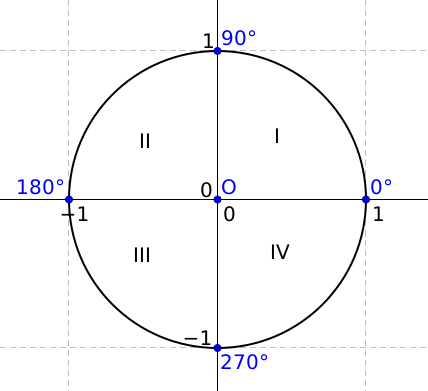
The circle is also divided into four parts, which we call quadrants. The first quadrant is at the top right, the second at the top left, the third at the bottom left and the fourth at the bottom right. Because we will use this circle to show angles, the degrees are marked on the circle. An angle of zero degrees is where the arm of the angle usually starts, pointing to the right. That is why the point (0, 1) is marked 90°, a right angle.
Defining sine and cosine on the circle
The unit circle is a very nice way to show the individual trigonometric functions. First we draw some angle on the unit circle, and then we show where on the unit circle we can read off the values of the functions.
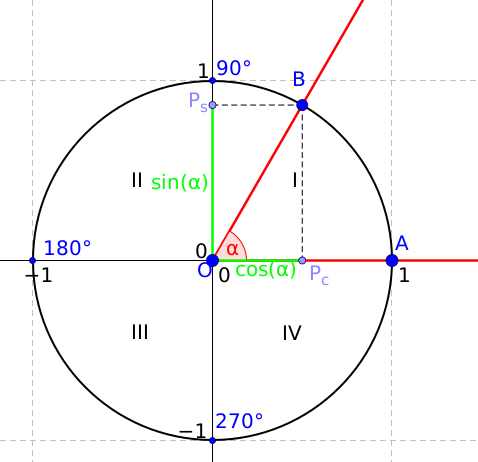
We have drawn angle AOB on the circle (in red). We have called this angle alpha. The arms of the angle meet the unit circle at two points: A and B. The point B is the important one for us. If we draw a line from B parallel to the x-axis (the dashed horizontal line in the picture), it meets the y-axis at exactly one point. Let’s call this point Ps. The length of the line segment OPs (the green segment) is equal to the sine of angle alpha.
Because we are working in the unit circle, whose centre is at the origin of the coordinate system, the length of the line segment OPs (the green segment) is equal to the y-coordinate of Ps, which is equal to the y-coordinate of B.
We can read off the cosine on the same circle. This time we draw a line parallel to the y-axis through B. This line meets the x-axis at a point that we will call Pc. The length of the line segment OPc is then equal to the cosine of angle alpha. Again, we can say that this value is equal to the x-coordinate of B and of Pc.
Defining tangent and cotangent
In the same way as we defined sine and cosine on the unit circle, we can define tangent and cotangent here. To make it clear, we first show where the tangent appears on the unit circle. For this we need another line. It is the line that is parallel to the y-axis and passes through A, that is, through the point (1, 0). In the following picture it is the blue line:
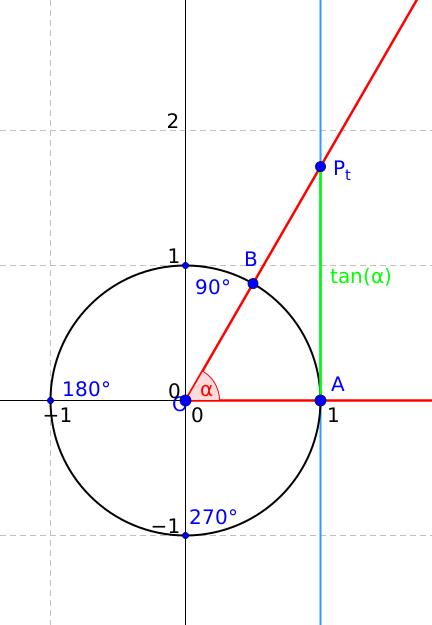
This line meets the ray (the arm of the angle) OB at one point, which we will call Pt. The length of the line segment APt is then equal to the tangent of angle alpha. Again, it is enough to take the y-coordinate of Pt and we also get the tangent of angle alpha.
To show the cotangent on the unit circle, we need one more line. This time it is the line that passes through the point (0, 1) and is parallel to the x-axis. Again it is highlighted in blue:
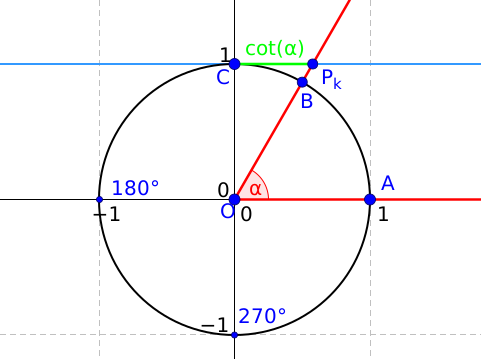
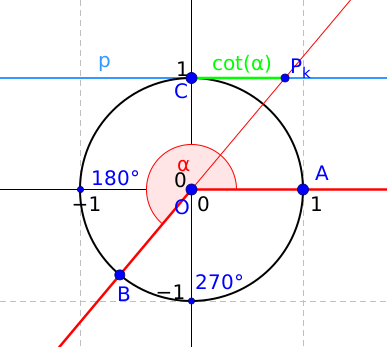
This line meets the ray (the arm of the angle) OB at one point, which we will call Pk. The length of the line segment CPk is then equal to the cotangent of angle alpha. As always, we can just take the x-coordinate of Pk and we get the cotangent of the angle.
The question is what happens when angle alpha is greater than 90 degrees for the tangent, or greater than 180 degrees for the cotangent, because in these cases the line does not meet the arm of the angle, as the following picture shows:
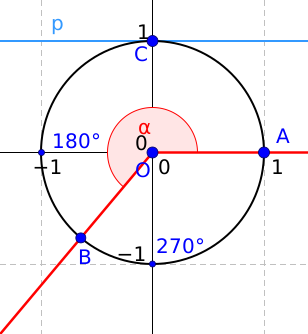
At this point we extend the ray OB into a full line, and this line does meet the line p.
We would do the same for the tangent.
When tangent and cotangent are not defined
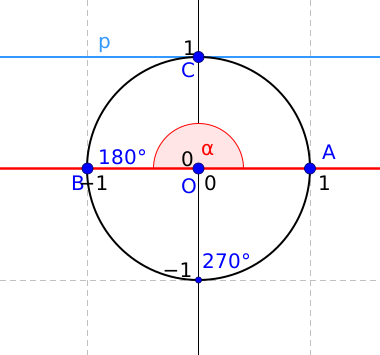
On the unit circle we can notice something interesting. If angle alpha is equal to 180 degrees, then the line p and the arm of the angle never meet, because they are parallel. How do we fix this problem? We don’t: the cotangent of 180 degrees is not defined. In the same way the tangent of 90 degrees is not defined, because that arm is parallel to the y-axis and so it is parallel to the line it should meet. The following picture shows this, at least for the cotangent.
Chapters: Trigonometric functions, The unit circle, Inverse trigonometric functions, Properties of sine, cosine, tangent and cotangent, Trigonometric formulae, Graphs of trigonometric functions, Sine rule and cosine rule
