
Properties of sine, cosine, tangent and cotangent
Sine and cosine are the basic trigonometric functions.
Sine
The sine of an angle alpha is equal to the ratio of the length of the opposite side to the length of the hypotenuse in a right-angled triangle.
The graph of the sine function is a curve called a sine curve. You can see it in the following figure:
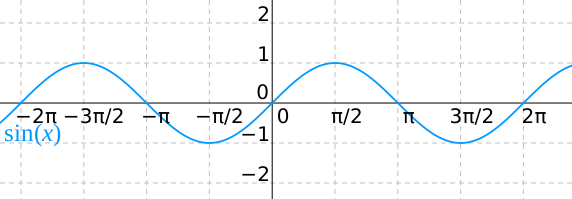
Sine is a periodic function whose smallest period is 2π. Its other properties:
- The domain is the set of all real numbers.
- The range is the interval [−1, 1].
- Sine has a maximum at infinitely many points. More precisely, its “first” maximum is at
- Similarly for the minimum: sine has a minimum at the points
- Sine is an odd and bounded function.
Cosine
The cosine of an angle alpha is equal to the ratio of the length of the adjacent side to the length of the hypotenuse in a right-angled triangle. So if we work out the cosine of angle alpha on a calculator, we get the value of the ratio
The graph of the cosine function is a curve called a cosine curve. You can see it in the following figure:
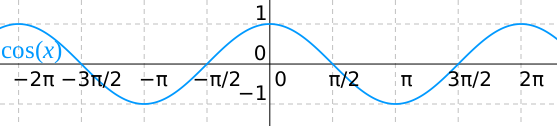
Cosine is a periodic function whose smallest period is 2π. Its other properties:
- The domain is the set of all real numbers.
- The range is the interval [−1, 1].
- Cosine has a maximum at infinitely many points. More precisely, its “first” maximum is at x = 0, and because the function is periodic, it also has a maximum at every point 2kπ, where k is an integer. The maximum value is 1.
- Similarly for the minimum: cosine has a minimum at the points π + 2kπ, where k is an integer, and its value is −1.
- Cosine is an even and bounded function.
Tangent
The tangent of an angle alpha is equal to the ratio of the length of the opposite side to the length of the adjacent side in a right-angled triangle. We write tangent as tan.
The graph of this function is a curve called a tangent curve:
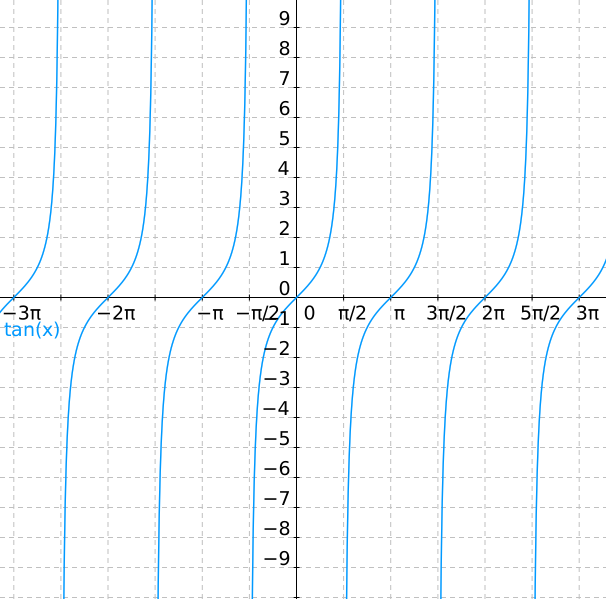
Tangent differs from the previous functions mainly in its period, which is no longer 2π but only π. Its other properties:
- The domain is the set
- The range is the set of all real numbers.
- Tangent has no maximum or minimum and is not bounded.
- Tangent is an odd function.
Cotangent
The cotangent of an angle alpha is equal to the ratio of the length of the adjacent side to the length of the opposite side. We write cotangent as cot.
The graph of this function is a curve called a cotangent curve:
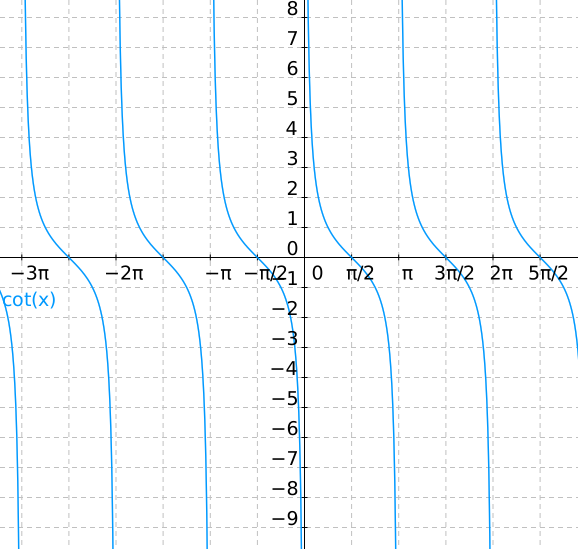
Its other properties:
- The period is also π, as for tangent.
- The domain is the set
- The range is the set of all real numbers.
- Cotangent has no maximum or minimum and is not bounded.
- Cotangent is an odd function.
The relationship between sine and cosine
The trigonometric functions are closely related. If you look at the graphs of sine and cosine together, you will see that they are not very different: one is just shifted a little compared with the other.
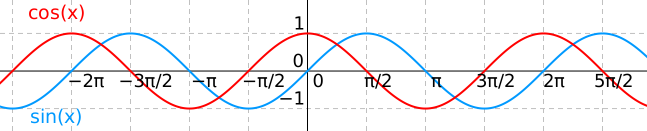
So if we always add π/2 to the input of the sine function, we get the cosine function:
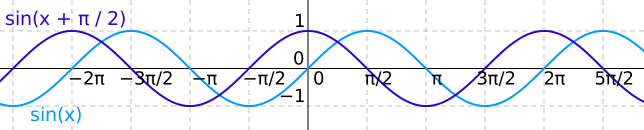
And the other way round, if we subtract π/2 from the input of cosine, we get sine.
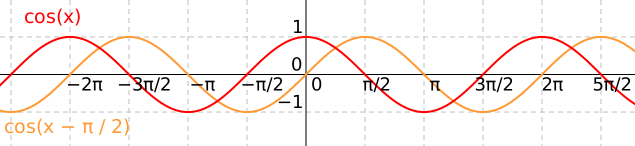
So we can write these formulae:
Expressing tangent and cotangent
We can easily express tangent using sine and cosine. We just need to remember what tangent is: the ratio of the length of the opposite side to the length of the adjacent side. Let’s use this triangle to help us:
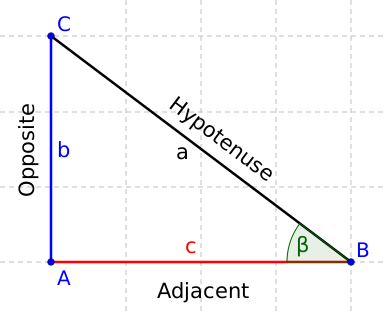
What is the tangent of angle beta equal to?
How could we express the numerator or the denominator? What are the lengths of sides b and c equal to? We know that the sine of angle beta is
Rearrange this formula to make b the subject:
The cosine of angle beta is
Make c the subject:
Now we have the lengths of sides b and c expressed using sine and cosine. Let’s substitute these intermediate results into the original equation for tangent:
We can cancel a from the numerator and the denominator, which gives the final formula:
So we can write tangent as sine divided by cosine. Without proving it, we will simply state that cotangent is the same fraction upside down, that is, cosine divided by sine.
The relationship between tangent and cotangent
Just as sine and cosine are similar, so are tangent and cotangent. Look at both graphs in one figure:
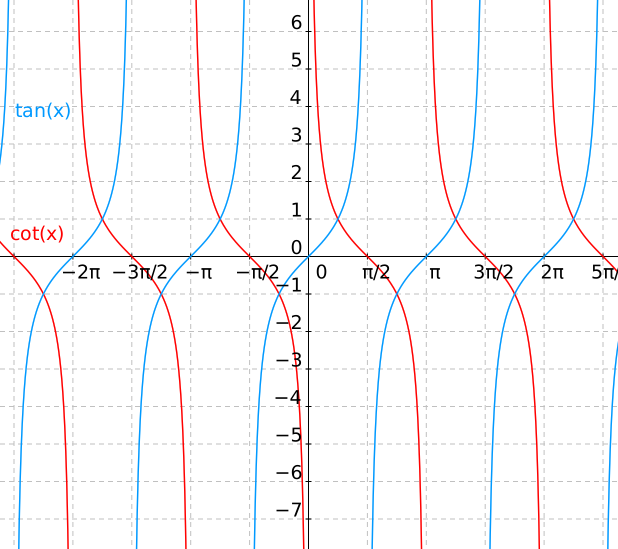
How do we turn the curve that describes tangent into the curve that describes cotangent? Cotangent is shifted by π/2, so we start with that:
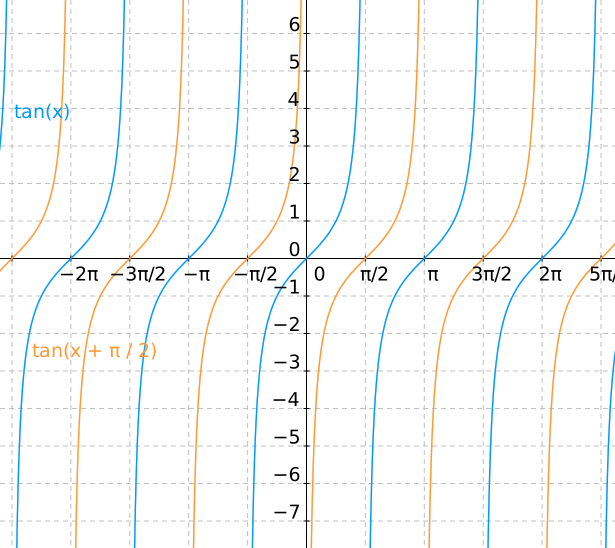
We are closer to cotangent now, but the curves still go the wrong way: on the chosen intervals cotangent is decreasing, whereas this shifted curve is increasing. We fix that by changing the sign of the variable x:
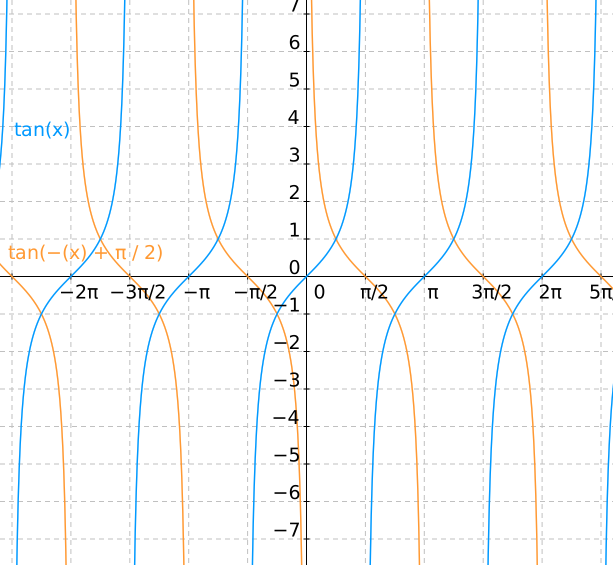
So we can write:
Exact values
Sine, cosine, tangent and cotangent have nice exact values for some angles. Here is a summary of the basic ones:
Chapters: Trigonometric functions, The unit circle, Inverse trigonometric functions, Properties of sine, cosine, tangent and cotangent, Trigonometric formulae, Graphs of trigonometric functions, Sine rule and cosine rule
