
Directed angle
The arms of an angle split the plane into two undirected angles, a larger one and a smaller one (unless they are equal). To make clear which angle we mean, we introduce the idea of a directed angle.
Why introduce a directed angle
Look at the following picture, which shows angle AVB.
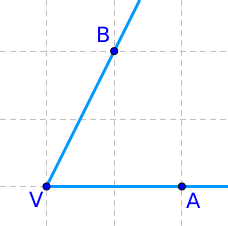
The question now is which of the two angles we mean. You probably assumed I meant the smaller one, but I could just as well be talking about the larger one. The next picture shows two different angles formed by the same two rays:
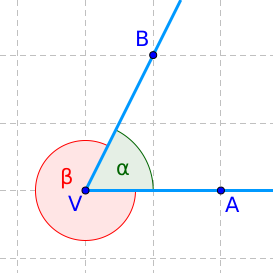
Without further information we cannot say whether “angle AVB” means alpha or beta. To agree on which angle we are talking about, the idea of a directed angle was created.
Positive and negative direction
A directed angle helps us specify which angle we mean. For that we need to define two things. First, the arms of the angle must be given in the correct order. That is why we distinguish between angle AVB and angle BVA, even though the arms are the same – rays VA and VB. For angle AVB, ray VA is called the initial arm of the directed angle and ray VB the final arm. The common point V is called the vertex of the directed angle.
Good, so we know that the order of the arms matters. But we still do not know which way to turn to get angle AVB. Angle AVB could have been formed in two directions, as the next picture shows:
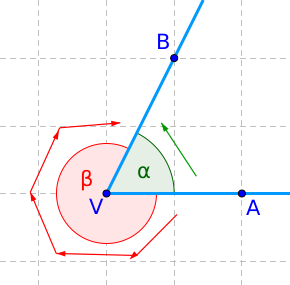
The initial arm of the angle is ray VA. From there we can sweep out the angle in two directions, shown by the green arrow and the red arrows. We could name the directions in the usual way: the green direction is anticlockwise and the red direction is clockwise.
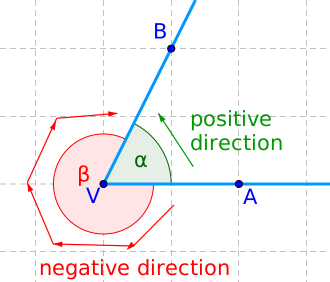
In maths, however, we use different names for these directions: the positive and negative direction. The positive direction corresponds to the green arrow, that is, anticlockwise. The negative direction corresponds to the red arrow, that is, clockwise.
The next picture shows this clearly:
What a directed angle is
A directed angle is an ordered pair of rays with a common starting point. We could write a directed angle as a pair of rays, for example like this:
but there is a shorter notation:
Now we define the principal value of a directed angle. The principal value of the directed angle
The principal value is always in the interval [0°, 360°). Notice that the interval is open on the right. The principal value cannot equal 360 degrees. That angle coincides with an angle of zero degrees, so we write zero degrees instead of 360 degrees. If we work in radians, the angle lies in the interval [0, 2π).
Besides the principal value there is also simply the size of a directed angle. It is defined in the same way, except that this size can be larger than the principal value. If we make a full turn and keep moving the initial arm, we can create an angle larger than 360 degrees. If we turn through one and a half full turns, we get an angle of 360 + 180 = 540 degrees. This is a valid size of a directed angle. However, this angle is identical to an angle of 180 degrees.
We can easily convert any such size of a directed angle to the principal value: divide the size by 360, keeping only the whole-number part, and take the remainder as the principal value. Let’s convert those 540 degrees to a principal value:
The same works for other sizes. For example, for angles of 750, 1,080 and 2,000 degrees we get:
The angles have principal values of 30, 0 and 200 degrees. If we work in radians, we divide by 2π.
Chapters: Angle, How to construct an angle bisector, Copying an angle, Radian measure of angles, Directed angle, Sum of angles in a polygon, Converting road gradient to an angle
