
Sum of angles in a polygon
If we add up the interior angles of any triangle, we always get 180°. It does not matter whether it is acute, obtuse or no bigger than a postage stamp. But what about a quadrilateral, a pentagon or a hexagon? What do their angles add up to?
Splitting it into triangles
Take pentagon ABCDE and from vertex A draw diagonals to all the vertices it is not already joined to by a side. These are diagonals AC and AD. They split the pentagon into three triangles:
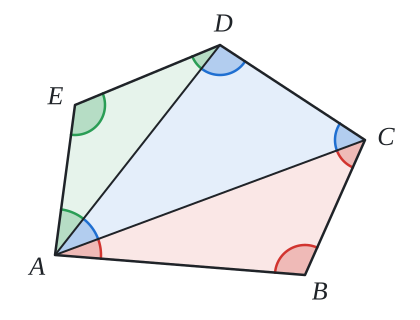
Look at the coloured angles. Each angle of a triangle lies at some vertex of the pentagon, and together they fill all the interior angles of the pentagon: nothing is left over and nothing is missing. At vertex A the angles of all three triangles meet, at C and D only those of two. So the pentagon has the same angle sum as three triangles together, 3 · 180°.
Exactly the same happens for every convex polygon. From one vertex, diagonals go to all the other vertices except the two neighbouring ones, so an n-sided polygon splits into n − 2 triangles. The sum of the interior angles of an n-sided polygon is therefore
The formula also holds for non-convex polygons, that is, ones with an interior angle greater than 180°. They can be split into triangles too, but the diagonals need not all start from one vertex.
A quadrilateral has four vertices, so we substitute n = 4:
It works for a square as well: its four right angles add up to exactly 4 · 90° = 360°.
For a pentagon, n = 5:
And a hexagon, that is, n = 6:
With every extra vertex one more triangle appears, and the angle sum grows by 180°.
Why not n triangles?
A polygon can be cut up in another way too. We choose a point S inside and join it to all the vertices. The pentagon is then split into five triangles. The tempting conclusion is that the angle sum is 5 · 180°. But that is a mistake.
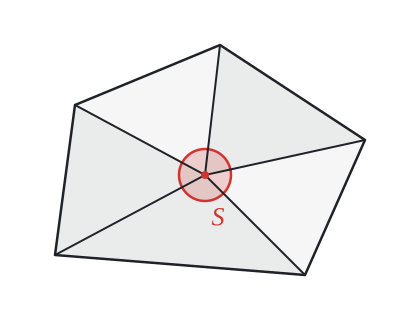
The angles of the triangles at point S do not belong among the interior angles of the pentagon. Together they make a full turn of 360°, and we have to subtract it:
We got the same as before. And we get the same result for every convex n-sided polygon, because 360° = 2 · 180°:
Regular polygons
In a regular polygon all the sides are equally long and all the angles are equally large. We get one angle by dividing the sum of all the angles by their number n:
The angles of a regular pentagon measure 540°:5 = 108°, and for a regular hexagon it is 720°:6 = 120°.
Bees build regular hexagons. The honeycomb is made of them without a single gap, because three hexagons meet at every vertex and their angles add up to
that is, exactly a full turn.
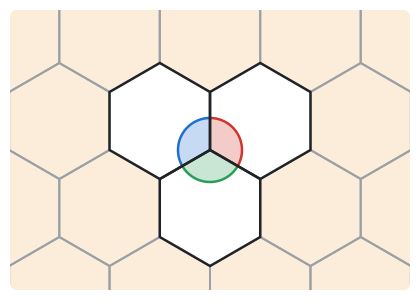
With regular pentagons this would not work: three angles of 108° make 324°, so a gap would be left, and four make 432°, which is already too much. To find out how to work out the area of a regular polygon, see the article area of a regular polygon.
The exterior angles add up to 360°
An exterior angle is formed when we extend a side of a polygon past a vertex. It is the angle between the extension and the next side. Imagine walking round a pentagon along its perimeter. At every vertex you turn by exactly the exterior angle. When you get back to the start, you are facing the same way as at the beginning, so you have turned once all the way round, through 360°.
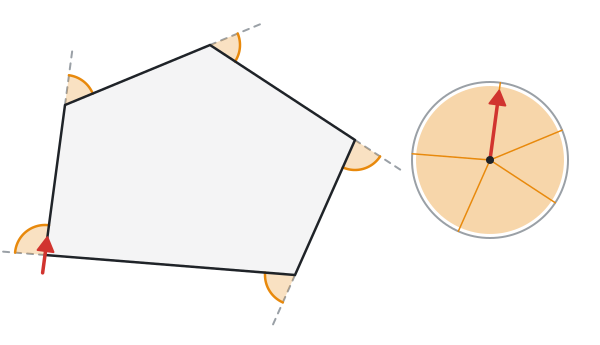
The dial on the right shows how far the arrow has turned in total so far.
The same comes out by calculation. The interior and exterior angle at one vertex are angles on a straight line, so together they make 180°. For n vertices that is n · 180° in all. Of this, (n − 2) · 180° goes to the interior angles, and what is left for the exterior ones is
The number of vertices does not matter. The sum of the exterior angles of a convex polygon is always 360°, whether it is a triangle or a polygon with a hundred sides.
See also
Chapters: Angle, How to construct an angle bisector, Copying an angle, Radian measure of angles, Directed angle, Sum of angles in a polygon, Converting road gradient to an angle
