
Radian measure of angles
The radian is – like the degree – a unit for measuring the size of angles. It is defined on the unit circle, and its size is the angle at the centre of an arc whose length equals the radius of the circle.
Definition
To define radian measure we need the unit circle. On this circle we mark two points A and B so that the arc between them has length one, that is, so that the length of the arc is the same as the radius of the circle. If we label the centre of the circle as point O, then angle AOB has a size of exactly one radian.
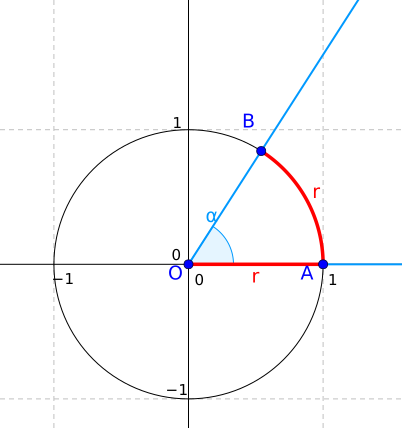
Line segment AO is a radius of the circle and is coloured red. The other red line, arc AB, must be just as long. The important thing is that we are not interested in the straight-line distance between points A and B, that is, line segment AB, but in the length of the arc itself.
What is the value of a radian in degrees? It is approximately 57° 17′ 45′′. We cannot work out the exact value. The question then is what such a unit is good for.
Practical calculations with radians
First we answer the question of how many radians make up the whole circle, that is, how many radians correspond to 360 degrees. We know that the arc length for one radian is exactly the radius of the circle. How many such arcs can we fit around the whole circle? The whole circle has a length (its circumference) of exactly
Our arc has length r, so to find out how many times the arc fits around the circle, we have to divide circumference / r, which gives:
The answer is that we can fit 2π such arcs around the whole circle. That is already quite a nice number. So we can write that
We often leave out the unit rad itself and simply write an angle of size, for example, 2π.
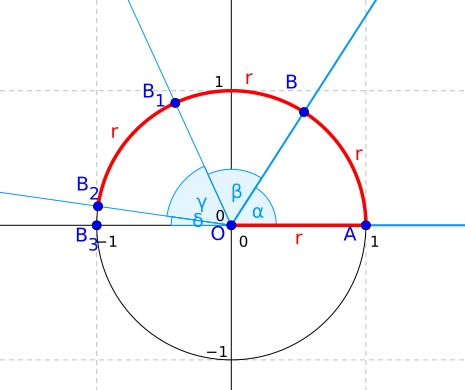
The next figure shows three angles of size one radian, the angles alpha, beta and gamma. You can see that the sum of their sizes is almost 180 degrees. But since we would need π radians for 180 degrees, and π is approximately 3.1415…, there is still a little bit missing.
Converting from degrees to radians and back
Most devices and programs that calculate trigonometric functions work in radians by default. This is a bit of a problem if you are given an angle in degrees. You have two options: if possible, switch the device so that it works in degrees, or convert degrees to radians.
For example, the Google search engine has a built-in calculator, so you can work out the value of the sine function there. By default, though, it works in radians, so when we try to calculate sin(30), we do not get the correct result 0.5, because Google did not understand it as thirty degrees but as thirty radians. However, if we add the word “degrees” after the number, it calculates it correctly: sin(30 degrees). Most calculators also have two modes, one working in degrees and the other in radians. It is usually controlled by a button labelled rad or deg. Rad is short for radian and deg is short for degree.
If there is no way around it, you have to convert degrees to radians or the other way round. We begin with the first: converting from degrees to radians. We already know that 180° = π rad. We would like to know what fraction of a radian one degree is, so we divide the equation by 180:
Now we know how many radians one degree is. If we need to work out, for example, thirty degrees, we multiply this fraction by thirty:
The same goes for other angles.
Now the opposite case, converting from radians to degrees. Again we start from 180° = π rad. If we have 2π radians, we get twice as many degrees, that is, 360. If instead we have only half of π radians, we get half the number of degrees – 90. So first we divide our value in radians by π, which tells us what multiple of 180 degrees the angle is. Then we multiply the value by 180 and we have the angle in degrees. So if we have an angle of 3π/2 radians, after dividing we get:
We multiply this result by 180 and we have the angle in degrees: 3/2 · 180 = 270. If we have two radians, we get:
The basic relationship between a value in radians and a value in degrees is given by this formula (rad is the value in radians and deg is the value in degrees):
History
The concept of the radian was probably first devised by Roger Cotes in 1714. At that time his unit did not yet have the name “radian”, but the other definitions and properties were identical. The term “radian” first appeared in print on 5 June 1873, in an article by James Thomson. The unit might still have been called “radial” or just “rad”. (Source: Wikipedia)
Table of basic conversions
Some angles are used quite often, so the following table gives values in degrees and their equivalents in radians:
Chapters: Angle, How to construct an angle bisector, Copying an angle, Radian measure of angles, Directed angle, Sum of angles in a polygon, Converting road gradient to an angle
