
How to construct an angle bisector
Every angle has a bisector, which is the line that passes through the vertex of the angle and cuts the angle in half. It follows from this definition that every point on the bisector is the same distance from the first arm as from the second. The bisector is usually labelled with a lowercase letter, such as l.
Describing the angle bisector
If we have angle ABC, its bisector would look like this:
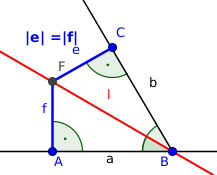
The bisector is drawn as the red line. This line cuts the angle in half. That means that if we choose any point on the bisector, for example F, then angles ABF and FBC have the same size.
The angle bisector has another nice property. Draw two line segments, CF and AF, that meet the arms of the angle at right angles, so that angles BCF and BAF are right angles. Then line segments CF and AF have the same length. If we moved point F further along the bisector, it would still be true that line segments CF and AF, moved in the same way, would have the same length.
How to construct an angle bisector
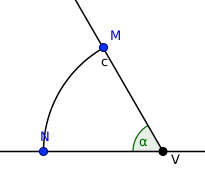
Constructing an angle bisector is no problem. All you need is a pair of compasses, a ruler and a pen, or better still a pencil (but we all know there is nothing like drawing with a pen). First draw a circle of any size centred on the vertex of the angle whose bisector you want to construct. This circle will cut each arm of the angle at exactly one point, let’s call them M and N.
Then set the compasses to any distance (the same one is fine, but it must not be a small radius – you will see why in a moment) and draw circles of the same size, first centred on M and then centred on N.
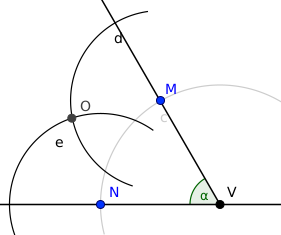
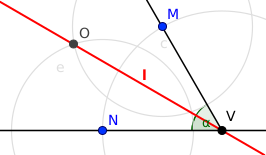
Where the circles meet, there is one point of the bisector, which we label O. The other point of the bisector is at the vertex of the angle. Draw a line through these two points and you have the bisector.
Chapters: Angle, How to construct an angle bisector, Copying an angle, Radian measure of angles, Directed angle, Sum of angles in a polygon, Converting road gradient to an angle
