
Copying an angle
If you have an angle and want to copy it somewhere else, you can use the method of copying an angle.
How to copy an angle
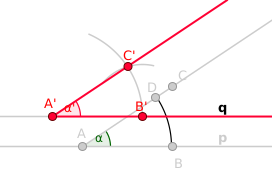
We start with this figure:
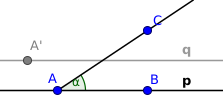
Our task is to copy angle α a bit higher up, so that the vertex of the copied angle α' is at point A', so that it has the same orientation, and so that its lower arm lies on line q (in the top figure it is shown in grey). Now we will need a pair of compasses. Draw part of a circle of any radius between the arms of angle α, centred on the vertex of the angle, A. Keep the compasses set to the radius of this circle.
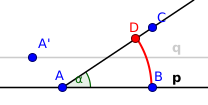
Now draw the same part of a circle with the same radius, but centred on point A', that is, where the vertex of the copied angle is to be. Where the circle meets line q, there will be point B'.
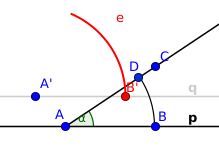
Now set the compasses to the distance |BD|, put the point of the compasses on B' and draw a circle. Where this circle meets the previous part of a circle, there is point C'.
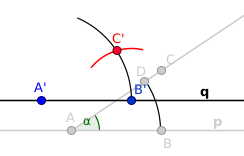
Now we have all three points needed to construct the new angle B'A'C'.
Adding and subtracting angles
If you have two angles that you need to add, you can use this method. Take one angle and copy it next to the other so that they share one arm, and the resulting angle is formed by the arms that differ between the two angles:
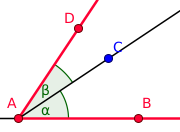
This example shows the sum α + β. The common arm is ray AC, and the different arms are rays AB and AD. The result is angle BAD.
Subtraction works very similarly, except that you copy one angle not outside the other angle but inside it. Then you take the overlap of the two angles away from the larger angle, so to speak, and you have the difference.
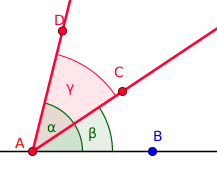
The figure shows the difference α − β. The red part again highlights the resulting angle.
Chapters: Angle, How to construct an angle bisector, Copying an angle, Radian measure of angles, Directed angle, Sum of angles in a polygon, Converting road gradient to an angle
