
Congruent triangles
Two triangles are congruent if you can cut one of them out of paper and cover the other one exactly with it. You may move the cut-out triangle however you like: slide it, rotate it, and even flip it over to its other side. You just must not stretch or shrink it.
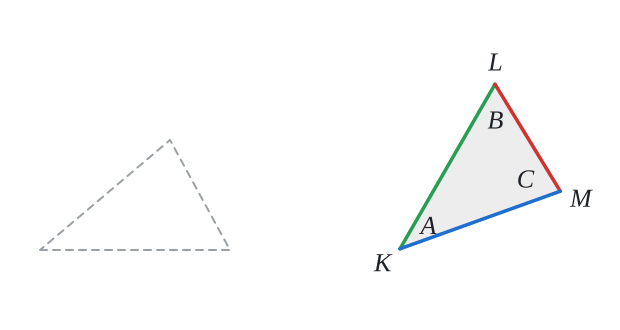
In congruent triangles, corresponding sides are equal in length and corresponding angles are equal in size. In the figure, corresponding sides have the same colour: side AB is as long as KL, side BC as LM and side AC as KM. It is written like this:
The order of the vertices in the notation is not random. It tells you which vertex lands on which: A on K, B on L and C on M.
Conditions for congruence
A triangle has six parts: three sides and three angles. To tell that two triangles are congruent, you do not need to compare all six. Three are enough, as long as they are chosen correctly. Four conditions for congruence tell you which triples work. In the figures, these three parts are highlighted in colour.
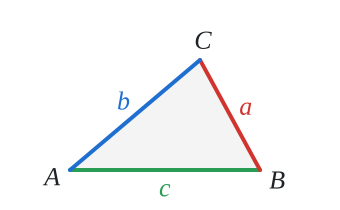
SSS (side, side, side): Two triangles with all three pairs of sides equal are congruent. Remember how to construct a triangle from three sides. We find point C with compasses as the intersection of two circles. They do meet at two points, above side AB and below it, but the two resulting triangles are just mirror images of one another. So three sides always give the same triangle.
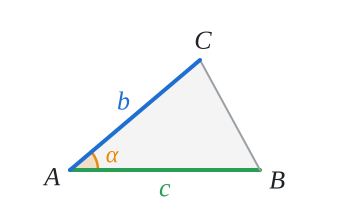
SAS (side, angle, side): Two sides and the angle between them are enough. The angle must lie at the vertex where the two sides meet.
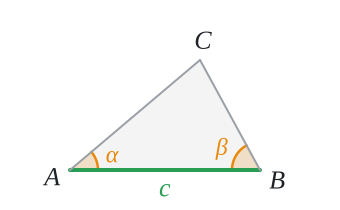
ASA (angle, side, angle): One side and the two angles next to it are enough. The arms of the two angles meet at a single point, the third vertex.
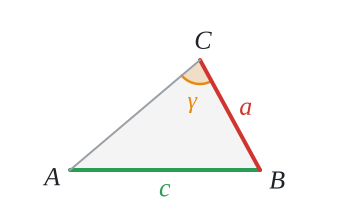
SSA (side, side, angle): Two sides and an angle are enough, provided the angle is opposite the longer of the two sides. The letters S, S, A on their own do not say which side the angle belongs to, so remember the condition: the angle is opposite the longer side.
When it is not enough
It is very tempting to say that any three parts will do. They will not.
Three equal angles are not enough. A triangle with the same angles can be any size, just like a photo and its enlargement. Such triangles have the same shape but not the same size, and we call them similar.
Two sides and an angle opposite the shorter of them do not work either. Let us try to construct such a triangle. First we draw the angle α and mark off side c = |AB| on one of its arms. Point C lies on the other arm and is a distance a from point B, so we draw a circle around B with radius a. If a is less than c, the circle can cross the arm at two points:
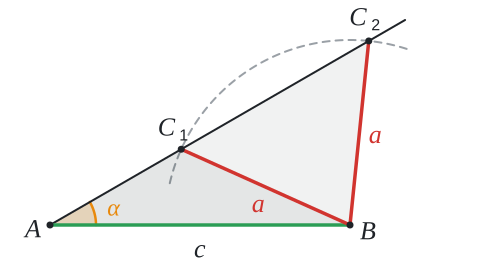
Triangles ABC1 and ABC2 have equal sides a and c and the same angle α, and yet they are not congruent. If a were greater than c, the circle would cross the arm only once. And that is exactly what the SSA condition says.
Example: the width of a river
Imagine you are standing on a riverbank at point A, and directly opposite you on the far bank there is a tree S. How can you find the width of the river if you cannot stretch a tape measure across it?
You walk along the bank and after 20 metres you drive in a peg P. Then you walk another 20 metres to point B. There you turn at a right angle away from the river and keep walking until the peg and the tree line up. Point C is at that spot.
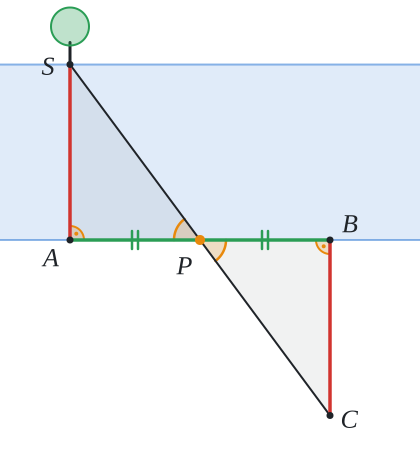
Triangles APS and BPC are congruent by the ASA condition. Sides AP and BP both measure 20 metres. The angles at A and at B are right angles. The angles at the peg P are vertically opposite, and therefore equal in size as well. It follows that
and side BC is as long as side AS, that is, as the width of the river.
Say you counted 36 paces from B to C, and one pace is about 75 cm. The distance |BC| then comes out as
The river is roughly 27 metres wide, and you did not even get your feet wet.
See also
Chapters: Triangle, Altitude of a triangle, Median of a triangle, Circles in a triangle, Right-angled triangle, Constructing a triangle, Congruent triangles, Similar triangles, Area of a triangle, Pythagoras’ theorem
