
Altitude of a triangle
An altitude (perpendicular height) of a triangle is a line segment. One endpoint of the segment is a vertex of the triangle and the other endpoint is a point on the opposite side of the triangle, and the altitude itself must be perpendicular to that side.
Acute-angled triangle
It is easiest to see in a figure:

We drew the altitude from vertex C. The other endpoint lies on the opposite side AB (that is, side c), and the segment CPc is perpendicular to side c. The point Pc is called the foot of the altitude, and we call side c the base. We usually name the foot with the letter P and a subscript showing the vertex the altitude comes from. Here that is vertex C.
An altitude is quite easy to draw: take a ruler and draw a perpendicular to side c that passes exactly through point C. That is all.
We can draw an altitude from every vertex of the triangle. All the altitudes then meet at a point called the orthocentre. The orthocentre may lie inside the triangle, but it does not have to. In an acute-angled triangle the orthocentre lies inside the triangle:
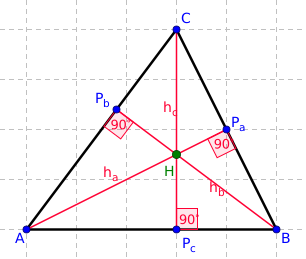
All three altitudes of the triangle are marked in red. Notice that each altitude is perpendicular to its side. We denote altitudes by the lowercase letter h with a subscript showing the vertex the altitude comes from. For the altitude BPb we therefore speak of the altitude hb. The orthocentre itself is the green point H.
Obtuse-angled triangle
In an obtuse-angled triangle you have to use a little trick. The orthocentre ends up outside the triangle, and some altitudes cannot actually meet the sides they are supposed to meet. The solution is to “extend” the sides of the triangle as far as needed. Again, look at the figure:
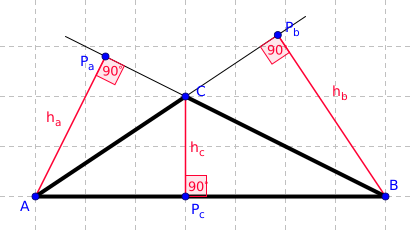 The triangle ABC is the one drawn in bold. It is obtuse-angled: angle ACB is greater than 90 degrees. The altitude from vertex C is easy to draw, but the altitude from vertex B causes a problem. There is no perpendicular to side AC that passes through both side AC and vertex B. We solve this by drawing the ray AC, which extends side AC as far as we need. We look for the perpendicular on this ray, and now we can find it. The foot of the perpendicular lies on the newly drawn ray. We draw the remaining altitude in the same way.
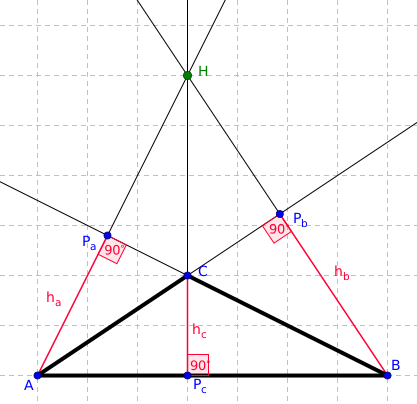
Now all three altitudes of the triangle are drawn. The problem is that these altitudes never meet, so they do not form an orthocentre. To fix that, we draw three new rays in the directions of the altitudes so that they meet somewhere above the triangle. We do not change the altitudes themselves.
Right-angled triangle
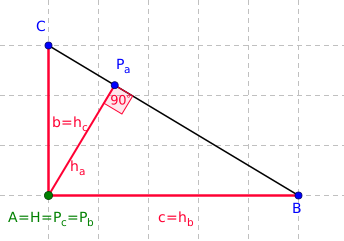
In a right-angled triangle it is simplest of all, because two of the altitudes coincide with two sides of the triangle, namely the two shorter sides (the sides adjacent to the right angle). The orthocentre is then at the vertex opposite the hypotenuse.
Length of an altitude
Sometimes you need to work out the length of an altitude. We start from the figure for the altitude in an acute-angled triangle.
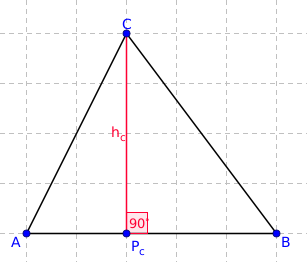
The altitude hc is marked there, so let’s try to work out its length. The altitude hc is of course perpendicular to side AB, and we can use that. We create a new triangle in which the altitude is easier to calculate. The triangle has vertices B, C and Pc. It is highlighted in red in the figure:
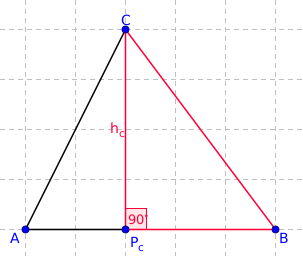
Now we use the trigonometric functions. We also need to know the angle at vertex B, the angle β. Then it is a simple application of sine, which gives the ratio of the opposite side to the hypotenuse. The opposite side here is hc, and the hypotenuse is side CB. So:
The angle β is approximately 53°8′ and side BC has length 5. Substituting, we get:
The altitude hc has length four.
Chapters: Triangle, Altitude of a triangle, Median of a triangle, Circles in a triangle, Right-angled triangle, Constructing a triangle, Congruent triangles, Similar triangles, Area of a triangle, Pythagoras’ theorem
