
Area of a parallelogram
The area of a parallelogram is the size of the region that the parallelogram covers. A parallelogram is a shape similar to a rectangle, but with two opposite sides slanted, as in the picture.
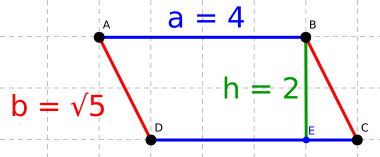
Let the lengths of the two different sides be a and b. We also need the height h perpendicular to side a. Given the height h, the area of the parallelogram, which we denote S, is
The parallelogram above has side a = 4 and height h = 2, so its area is
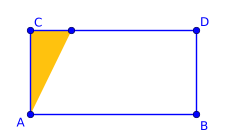
Why is the formula the same as for the area of a rectangle? Because we can take the triangle that sticks out on the left-hand side and move it to the right-hand side, where something is missing. The area does not change, but now we have a rectangle, so we can use the formula we already know.
Calculator
Chapters: Area of a square, Area of a rectangle, Area of a circle, Sector of a circle, Area of a trapezium, Area of a parallelogram, Area of a rhombus, Area of a regular polygon, Surface area of a sphere, Surface area of a cube, Surface area of a cuboid, Surface area of a cylinder, Surface area of a cone, Surface area of a pyramid
