
Surface area of a cone
The surface area of a cone tells us, in everyday terms, how much paper or sheet metal we need if we want to make the whole cone or cover it. Don’t confuse it with the volume of a cone, which tells us how much water fits inside. A cone has two parts: a circular base at the bottom and, above it, a curved surface that narrows to the vertex.
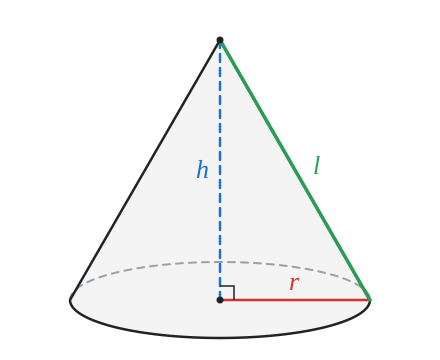
The base radius r is marked in red, the height h in blue and the slant height l in green – this is the distance from the vertex to the edge of the base.
Formula for the surface area of a cone
If all you need is the formula, the surface area A of a cone whose base has radius r and whose slant height is l is
The first term is the area of the base and the second is the area of the curved surface. The formula is sometimes written with the common factor π · r taken out:
Take a cone with base radius r = 3 and slant height l = 5. Its surface area is
If you would rather have an ordinary number than an answer with pi in it, substitute the approximate value 3.14:
Where does it come from?
The base is an ordinary circle, so we already know its area from the formula for the area of a circle: π · r2.
The curved surface is more interesting. If we cut it along the slant height and lay it out flat on the table, we get a sector of a circle with radius l. The diagram shows the whole net of the cone: the red sector is the curved surface and the blue circle is the base. In the diagram the net folds up into a cone and unfolds again.
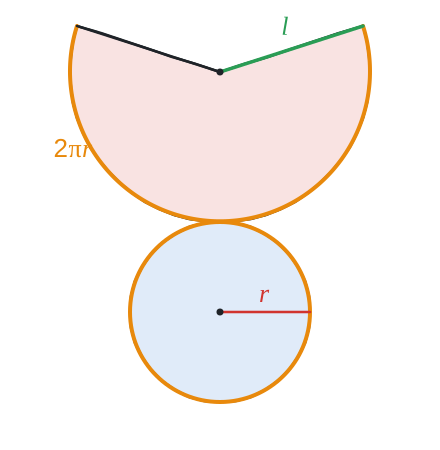
Before the cut, the orange arc of the sector was the edge of the base, so it is exactly as long as the orange circle below it, that is, the circumference of the circle 2π r. A whole circle of radius l would have circumference 2π l. The sector is the same fraction of the whole circle of radius l as the arc is of the whole circumference:
For the cone in the previous example this is three fifths of the circle, just as in the diagram. The whole circle would have area π · l2, and the curved surface takes the fraction
If we add the base to the curved surface, we get the whole formula A = π · r2 + π · r · l.
Example: a paper party hat
A party is coming up and we want to make a cone-shaped paper hat for it. It should have a radius of 8 cm at the bottom and a height of 15 cm. How much paper do we need for it?
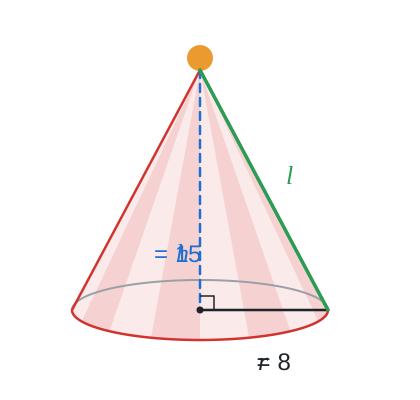
The formula, however, needs the slant height l, not the height. But the height, the radius and the slant height form a right-angled triangle, so we can find the slant height using Pythagoras’ theorem. Substitute r = 8 and h = 15:
Square the numbers:
All that is left is to take the square root:
But there is a trap here: a party hat has no bottom. Anyone who reached for the full formula would make a hat with a base, and that is rather hard to wear. So we work out only the curved surface:
Substitute the approximate value of pi:
We need approximately 427 square centimetres of paper for the hat, plus a little extra for gluing it together.
Calculator
Enter the base radius and the slant height; you can switch the units for each field. The calculator uses the exact value of pi, so its result comes out slightly higher than 75.36.
See also
Chapters: Area of a square, Area of a rectangle, Area of a circle, Sector of a circle, Area of a trapezium, Area of a parallelogram, Area of a rhombus, Area of a regular polygon, Surface area of a sphere, Surface area of a cube, Surface area of a cuboid, Surface area of a cylinder, Surface area of a cone, Surface area of a pyramid
