
Surface area of a pyramid
A pyramid is a three-dimensional solid that looks like, well, a pyramid. It has a base that it stands on and several triangular faces. The base is a polygon. Here is what a pyramid can look like:

Regular square-based pyramid
This is a regular square-based pyramid. It is regular because its base is a regular polygon, and it is four-sided because the base is a quadrilateral – in this case a square (squint a little to see the square 😆) – so the pyramid has four triangular faces. We work out the surface area of the pyramid by adding the area of the base and the area of the faces. We start with the area of the base:

We said that the base is a regular quadrilateral – in other words, a square – so we use the formula for the area of a square:
That was easy. Now comes the harder part – the area of a triangular face. Let’s work out the area of face ABF:

Face ABF is a triangle, and not just any triangle – an isosceles triangle:
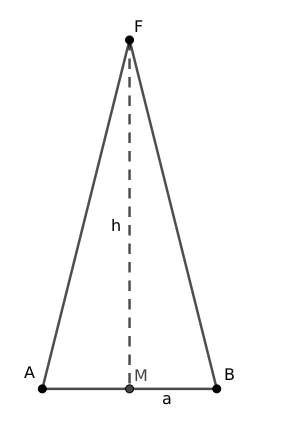
To work out the area of an isosceles triangle, we need to know the height of the triangle. Once we know the height h of the isosceles triangle, we can work out its area as
This is the area of one face of our square-based pyramid. The total area of all four faces is
Now we can work out the surface area of the whole pyramid by adding the areas of the base and the faces:
Surface area of a regular n-sided pyramid
A pyramid doesn’t have to be square-based, of course. It could be hexagonal, for example:

How would we work out the surface area of a pyramid like this? We still work out the area of one face as
But we don’t have four faces, we have six, so we multiply this area by six. For an n-sided pyramid, we multiply by n:
We then work out the area of the base using the formula for the area of a regular n-sided polygon:
where a is the length of an edge of the base and r is the perpendicular distance from the centre of the polygon to one of its sides. The whole formula looks like this:
We can simplify this to
and then to
Chapters: Area of a square, Area of a rectangle, Area of a circle, Sector of a circle, Area of a trapezium, Area of a parallelogram, Area of a rhombus, Area of a regular polygon, Surface area of a sphere, Surface area of a cube, Surface area of a cuboid, Surface area of a cylinder, Surface area of a cone, Surface area of a pyramid
