
Sector of a circle
A sector of a circle is a piece of a circle that looks like a slice of pizza or cake. You cut it out with two cuts that run from the centre to the edge. So a sector is bounded by two radii and a piece of the circumference between them.
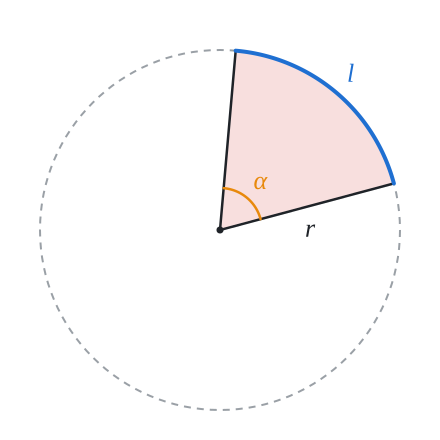
The sector itself is shaded red, and its area is what we are going to find. The black line segments are the two radii r, that is, the two knife cuts. The angle α between the radii is marked in orange. It is called the angle at the centre, because its vertex is at the centre of the circle. The arc l, shown in blue, is the piece of the circumference that bounds the sector on the outside – on a pizza, it is the crust.
Formulae for a sector
If you only want the formula, then the area A of a sector with radius r and angle at the centre α in degrees is
and the length l of the arc of the same sector is
For example, a sector with radius r = 6 and angle at the centre α = 60° has area
and its arc has length
If you do not like an answer with pi in it, you can substitute the approximate value 3.14:
How did we get this?
A full circle has an angle of 360° around the centre. A sector is the same fraction of the circle as its angle at the centre is of 360°. A sector with a 90° angle is a quarter of the circle, because 90° is a quarter of 360°. A sector with a 180° angle is half the circle, one with a 270° angle is three quarters, and one with a 360° angle is the whole circle:
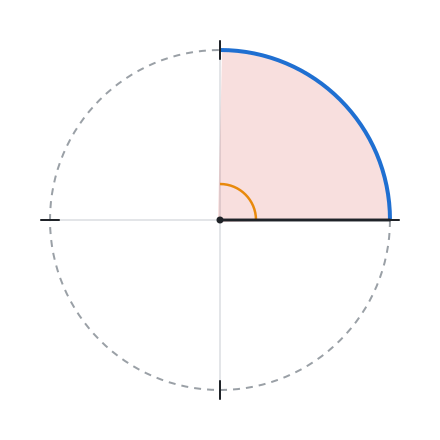
So the fraction of the whole circle that the sector takes up is
For 90° we get
so we get the area of the sector by multiplying it by this fraction:
The arc works in exactly the same way. As the angle opens, the blue arc grows with it, and at 360° it becomes the whole circumference. So the arc is the same fraction of the circumference of the circle as the angle α is of 360°. The circumference is
and the length of the arc is therefore
Example: pizza
A pizza has a diameter of 32 cm and is cut into 8 equal slices. What is the area of one slice?
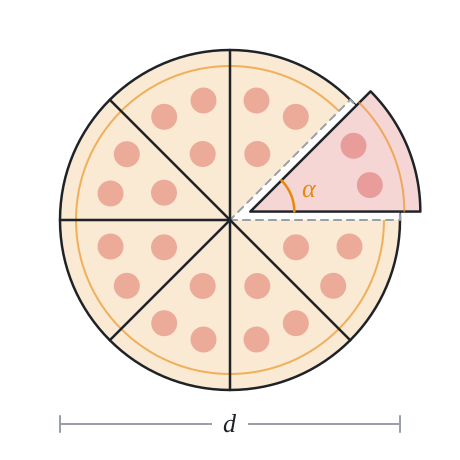
Each slice is a sector of a circle. First we need its angle at the centre. Eight equal slices share the full 360° between them, so one slice has angle
Now watch out for a trap: 32 cm is the diameter of the pizza, not the radius. The formula needs the radius, which is half the diameter, so r = 16 cm. Substitute into the formula for the area of a sector:
The fraction cancels to one eighth, which makes sense, because a slice is an eighth of the pizza. Square the 16:
Divide 256 by 8:
And finally substitute the approximate value of pi:
One slice has an area of approximately 100.48 square centimetres. If someone substituted the whole diameter 32 cm into the formula by mistake, they would get a slice four times as big, over 400 square centimetres. That would be a slice big enough to feed a whole family.
Example: clock
The minute hand on a wall clock is 15 cm long. How many centimetres does its tip travel in 20 minutes?
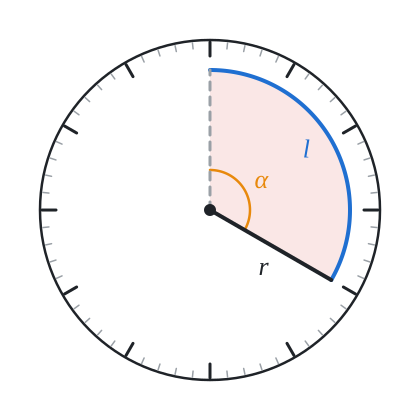
The tip of the hand moves along a circle whose radius is the length of the hand, so r = 15 cm. The distance it travels is the blue arc l. We still need the angle. In 60 minutes the hand goes once round, that is, 360°. In 20 minutes it goes a third of the way round:
Substitute into the formula for the length of an arc:
The fraction is one third and 2 · 15 = 30:
Substitute the approximate value of pi:
In 20 minutes the tip of the minute hand travels approximately 31.4 cm.
Finding the angle when we know the arc
Sometimes it is the other way round: we know the radius and the length of the arc and want to find the angle at the centre. We start with the formula for the length of an arc and rearrange it to make the angle α the subject:
Example: A car enters a roundabout and drives along a circle of radius 10 metres. Before it leaves the roundabout again, it covers 15.7 metres along the circle. Through what angle has it turned about the centre of the roundabout?
Substitute l = 15.7, r = 10 and 3.14 for pi, because the arc length is given approximately:
Multiply out the denominator:
The number 15.7 is exactly a quarter of 62.8, so the fraction cancels:
The car has turned through 90°, so it has gone a quarter of the way round the roundabout. We can check that we worked it out correctly: a quarter of the circumference is
Angle in radians
If your angle is given in radians, the formulae get simpler. A full circle is 360° = 2π radians, so the fraction that says how much of the circle the sector takes up is
Watch out: these shortened formulae need the angle in radians, not degrees. If you substituted 45, say, you would get nonsense.
For example, the pizza slice from the example above has angle 45°, which is
Calculator
You can also work out the area of a sector and the length of its arc here. You can enter the angle in degrees or in radians, and you can switch the units for each field.
See also
Chapters: Area of a square, Area of a rectangle, Area of a circle, Sector of a circle, Area of a trapezium, Area of a parallelogram, Area of a rhombus, Area of a regular polygon, Surface area of a sphere, Surface area of a cube, Surface area of a cuboid, Surface area of a cylinder, Surface area of a cone, Surface area of a pyramid
