
Worked examples in kinematics
You don’t learn physics by reading, only by calculating. Below are thirteen examples on motion, arranged from distance and displacement through acceleration and free fall to centripetal acceleration. In the last two, different kinds of motion take turns. We solve all of them by the same method: write down the data, convert the units, solve in general, substitute with units, estimate and give the answer in a full sentence. Try each example yourself first, and read the solution only afterwards.
Example 1: Clara walks the dog
Clara walks her dog round a square park with sides of 120 m. She sets off from one corner and walks along three sides of the park. What distance does she walk, and how large is her displacement?
Solution:
The distance is the length of the path, that is, of three sides of the park:
Displacement is the arrow from the starting point to the place where she ended up. After three sides of the square she is standing in the corner next to the starting one, so the displacement runs along the fourth side:
Answer: Clara has walked 360 m, but she is only 120 m from the place where she started. If she had gone all the way round the park, she would have walked 480 m and her displacement would have been zero.
Example 2: Uphill and downhill
George cycles up a hill along a road 3 km long at a speed of 12 km/h and rides back down the same road at 36 km/h. What is his average speed?
Solution: It is tempting to add the speeds and divide by two, which would give 24 km/h. But average speed is the total distance divided by the total time, and George takes much longer going up than going down.
We have everything in kilometres and hours, so no conversion is needed. The times are
We substitute:
Going up took George a quarter of an hour, going down five minutes. He covered the whole route in twenty minutes, and anyone who covers 6 km in a third of an hour would cover 18 km in an hour. Answer: George’s average speed is 18 km/h, not 24 km/h.
Example 3: Hannah leaves the hut
A walkers’ hut stands beside a path 4 km beyond a village. From the hut, Hannah continues away from the village at a steady speed of 5 km/h. How far from the village will she be after 1 hour 12 minutes?
Solution:
Watch the conversion. Twelve minutes is not 0.12 h but
Kilometres per hour times hours gives kilometres, which fits. In an hour Hannah walks 5 km, in 1.2 h a fifth more, that is 6 km, and with the hut that makes ten. Answer: Hannah will be 10 km from the village. Anyone who substituted 1.12 h would get 9.6 km.
Example 4: Jack catches up with his mum
Mum sets off from the house with a pram at 4 km/h. After a quarter of an hour Jack discovers she has forgotten her keys and runs after her along the same route at 10 km/h. How long does it take him to catch up with her, and how far from the house?
Solution:
After a quarter of an hour, Mum has a head start of s0 = v1 · t0 = 4 km/h · 0.25 h = 1 km. When catching up, the gap closes at the difference of the speeds:
In that time Jack runs
Check: Mum walks for 15 + 10 = 25 minutes, that is
Example 5: The cheetah
A cheetah accelerates from rest to 72 km/h in 2.5 s. What is its average acceleration? And what is its acceleration when it then stops from this speed in 4 s?
Solution:
By the formula for acceleration:
The cheetah’s acceleration is 8 m/s2: every second it is 8 m/s faster. A family car that takes ten seconds to reach 100 km/h has just under 3 m/s2, so the cheetah would easily beat it off the line.
When it stops, its speed falls from 20 m/s to zero in 4 s:
We take the direction of running as positive, so a negative acceleration means braking. Answer: When it stops, the cheetah has an acceleration of −5 m/s2, that is, a deceleration of 5 m/s2.
Example 6: How much runway does an aeroplane need?
An airliner starts from rest on the runway with a constant acceleration of 2 m/s2 and lifts off the ground at a speed of 252 km/h. How long a stretch of runway does it need, and how long does the take-off run last?
Solution:
We don’t know the time, so the relation without time
We work out the time of the take-off run from v = a · t:
Check using the average speed: for a start from rest it is half the final speed, 35 m/s, and in 35 s that gives 35 m/s · 35 s = 1,225 m. Answer: The aeroplane accelerates for 35 s and needs more than 1.2 km of runway. That is why big airports have runways several kilometres long, with a margin for a rejected take-off.
Example 7: A deer on a wet road
A driver is travelling on a wet road at 60 km/h and sees a deer 40 m ahead. The reaction takes 1 s, and on wet tarmac the car brakes with a deceleration of 5 m/s2. Will it stop in time?
Solution:
We leave the speed as a fraction so that we don’t round intermediate results. The total distance is the thinking distance plus the braking distance:
We substitute each part separately:
The total is
Example 8: A stone from a bridge
We drop a stone from a bridge, and it hits the river after 1.5 s. How high is the bridge above the water, and at what speed does the stone land? We ignore air resistance. How long would it fall from a bridge twice as high?
Solution:
This is free fall, and we choose downwards as the positive direction:
That is about 53 km/h. An estimate with g ≈ 10 m/s2 gives
Twice the height does not mean twice the time. From
Example 9: A drone in a crosswind
A drone flies at 12 m/s relative to the air, with its nose pointing due north. An easterly wind is blowing, that is, the air is moving west, at 5 m/s. How fast does the drone move relative to the ground, and by what angle does it deviate from north?
Solution:
The drone moves in two ways: it flies relative to the air, and the air carries it along. The resulting velocity is their vector sum, and since the two velocities are perpendicular, we use Pythagoras’ theorem:
We find the angle from north from the right-angled triangle of velocities, in which the wind velocity is the opposite side and the resulting velocity is the hypotenuse:
Simply adding would give 17 m/s, but the velocities are not in the same direction. The result must be greater than 12 m/s and less than 17 m/s, and 13 m/s is. Answer: Relative to the ground the drone moves at 13 m/s, and the wind turns it about 23° away from north towards the west. In a minute it carries it 300 m sideways.
Example 10: The Ferris wheel
A Ferris wheel at a fair has a radius of 20 m, and one revolution takes 4 min. What are its frequency and angular velocity, and how fast does a cabin on the rim travel?
Solution:
The frequency is the reciprocal of the period:
The angular velocity gives the full angle 2π in one period:
The speed of the cabin:
In one revolution a cabin covers the circumference of the wheel, about 126 m, in four minutes. That is about 1.9 km/h, a slow stroll. You could therefore get into a cabin while it is moving, as on big observation wheels.
Example 11: A centrifuge for pilots
A pilot training centrifuge has a cabin on an arm 8 m long. How many times a minute must it turn for the cabin to have a centripetal acceleration of 6g, that is, six times the acceleration due to gravity?
Solution:
From the formula for centripetal acceleration, ac = ω2 · r, we first express the angular velocity and then the frequency:
Units:
Per minute that is 0.432 · 60 ≈ 26 revolutions. One revolution takes about 2.3 s, and the cabin hurtles round at v = ω · r ≈ 21.7 m/s, almost 80 km/h. Answer: The centrifuge must turn about 26 times a minute.
Example 12: An Underground train between stations
An Underground train pulls out of a station with an acceleration of 1.2 m/s2 for 15 s, then travels at a steady speed for 30 s and finally brakes with a deceleration of 1.5 m/s2 until it stops at the next station. How far apart are the stations, and what is the train’s average speed?
Solution: We split the journey into three stages and use the formulas for one kind of motion in each.
Accelerating from rest. At the end of this stage the train has a speed of
and has covered
Travelling at a steady speed of 18 m/s, that is, about 65 km/h:
Braking from 18 m/s to a stop:
In total:
Answer: The stations are about 780 m apart, and the train covers the distance in just under a minute at an average speed of about 49 km/h. It travels at its top speed of 65 km/h for only about half the time, which is why the average is noticeably lower. A distance of around a kilometre is typical for a city underground.
Example 13: Reading a graph
The graph shows the speed of Felix’s electric scooter over twelve seconds. What acceleration did the scooter have in each stage, what distance did it cover in total, and what was its average speed?
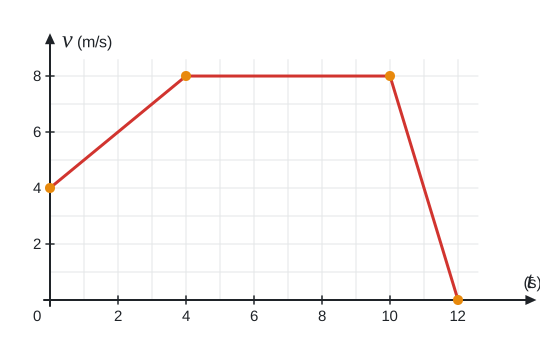
Solution: From the graph we read the speed at the points where the kind of motion changes: at the start 4 m/s, at 4 s it is already 8 m/s, at 10 s still 8 m/s and at 12 s zero. Acceleration is the change in speed divided by the time:
You can see this on the graph even without calculating: the steeper the stage, the greater the magnitude of the acceleration. A rising stage means positive acceleration, a horizontal one zero and a falling one negative: in the third stage the scooter has an acceleration of −4 m/s2, that is, a deceleration of 4 m/s2.
The distance is the area under the speed graph. The first stage forms a trapezium, the second a rectangle and the third a triangle:
In total s = 80 m in 12 s, and the average speed is
Check: the average speed must lie between zero and the top speed of 8 m/s, and since the scooter spent most of the time at 8, it will be closer to that. Answer: The scooter’s acceleration was 1 m/s2, then zero, then −4 m/s2; it covered 80 m at an average speed of about 6.7 m/s, that is, 24 km/h.
The same method can be used for problems involving forces. You will find them in the article Worked examples in dynamics.
