
Combining motions
When you walk along a moving escalator, you perform two motions at once: your legs carry you along the steps, and the steps carry you upwards. A boat on a river moves through the water, while the water carries it along the whole time. We get the resulting motion by combining the individual motions, which means adding their velocities as vectors, as arrows.
Walking on an escalator
An escalator on the Underground rises at a speed of v2 = 0.5 m/s and you walk up it at a speed of v1 = 1 m/s. You measure this speed relative to the steps; you would set off just as fast on an ordinary staircase. Relative to the station you move faster, because the steps move along beneath you on their own. Both arrows point in the same direction, so their magnitudes simply add up:
Every second you cover a metre along the steps, and the steps carry you another half a metre. If the escalator is s = 30 m long, you reach the top in
If you just stood still, the ride would take
Now, for a change, step onto an escalator that is going down and set off up it at the same pace. The arrows now point in opposite directions, so the magnitudes subtract:
You do get to the top, but the thirty metres take a whole minute again. If you walked at only half a metre per second, you would be marching on the spot. At an even slower pace, the escalator would slowly but surely carry you down.
So how fast are you actually walking? Two answers are correct. Relative to the steps it is 1 m/s; relative to the station it is 1.5 m/s or 0.5 m/s. It depends on the frame of reference, that is, on what we describe the motion relative to.
On the escalator both arrows lie along one line, so it is enough to add or subtract the magnitudes. Things get more interesting when the two motions point in different directions.
A boat crossing a river
A river is d = 60 m wide and flows at a speed of v2 = 1 m/s. A boat that travels at v1 = 2 m/s in still water sets off from the bank. The person steering points its bow straight at the opposite bank and keeps it pointing that way the whole time. Will it end up directly opposite the place it started from? Let’s write down what we are given:
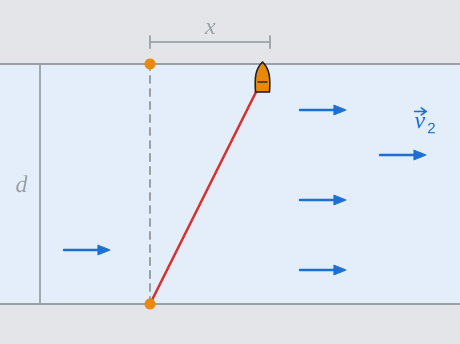
It won’t. While the boat pushes across, the water beneath it flows on and takes it along. The bow keeps pointing straight at the bank, but the boat moves at an angle and lands some way downstream. You can see it clearly in the animation: the boat does not travel where its bow points. The bow shows where the boat is going relative to the water. And by how many metres does the current carry it?
Motions don’t get in each other’s way
The key to the calculation is the principle of independence of motions: if a body performs several motions at the same time, each of them goes on as if the others did not exist. The body ends up in the same place as if the motions had taken place one after the other.
Let’s try this with the boat in two steps. First imagine that the water is still and the person steering rows for half a minute. The boat travels straight across and stops directly opposite. Then they stop rowing and for half a minute let the current carry the boat along the bank. It ends up exactly where it would arrive if it did both at once. In reality both motions happen at the same time, so the boat travels at an angle, but neither motion holds up the other.
With the boat this is easy to picture. Relative to the water it moves straight across, exactly as on a pond. The current simply moves that whole body of water, boat and all, downstream, just as the escalator moves the steps along with you. So the only thing driving the boat across is its own speed of 2 m/s. The current runs along the banks, so it neither helps nor hinders the crossing. The crossing time therefore depends only on the width of the river and the speed across it:
For all thirty seconds the current carries the boat along at 1 m/s. The distance by which the boat lands further downstream is called the drift:
The boat lands thirty metres downstream from the point directly opposite. For every two metres across, the current moves it one metre along the bank, so its track is a straight line. If the river flowed twice as fast, the boat would again reach the far bank in half a minute, but sixty metres from its target.
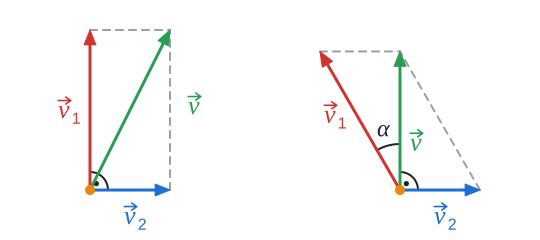
How fast does the boat move relative to the bank? The resultant velocity is the vector sum
We draw both arrows from one point and complete them to a parallelogram; the resultant velocity is its diagonal. The arrows are perpendicular, so the parallelogram is a rectangle here, as in the left-hand picture. We find the magnitude of the resultant velocity using Pythagoras’ theorem:
Relative to the bank the boat is faster than in still water, but the extra speed carries it somewhere other than where it wants to go. It would be a mistake to add the speeds as ordinary numbers, 2 m/s + 1 m/s = 3 m/s. Only arrows pointing in the same direction add up like that, as on the escalator.
We can check the result another way. In 30 s, moving at
It matches. The boat crosses the river in thirty seconds, moving at about 2.24 m/s relative to the bank, and lands thirty metres downstream.
How to land directly opposite
If the person steering wants to land exactly opposite, they must point the boat at an angle upstream. Part of its speed then fights the current and the rest drives it across. The resultant velocity
On the right, look for the triangle formed by the red arrow, the green arrow and the dashed line at the top. The dashed line is the opposite side of the parallelogram, so it is as long as the current’s arrow and parallel to it. It therefore makes a right angle with the green arrow, just like the current at the bottom. The hypotenuse is the boat’s velocity v1, and the current’s velocity v2 lies opposite the angle α. Therefore
The sine equals one half for an angle of 30°. The person steering must point the boat 30° upstream from the perpendicular.
The same result follows from resolving the boat’s velocity into two perpendicular components. One points upstream and has magnitude v1 · sin α, the other points across and has magnitude v1 · cos α. For the boat to travel straight across, the upstream component must exactly cancel the current, so v1 · sin α = v2 must hold. Dividing by v1 gives
The speed across is the remaining side of the right-angled triangle, which we work out using Pythagoras’ theorem:
We would get the same from v1 · cos α = 2 m/s · cos 30°. The principle of independence comes in handy a second time here. The crossing time is determined only by the speed across, which is now lower than before, so the crossing takes longer:
The direct route is shorter, yet it takes almost five seconds longer. Anyone who wants to reach the far bank as quickly as possible, such as a swimmer in a river, should aim straight across and put up with the drift. Anyone who wants to land at a jetty directly opposite must turn upstream and put up with a longer crossing.
Pilots know the same trick in a crosswind. The aeroplane flies with its nose pointing slightly into the wind so that it moves straight towards its destination relative to the ground. When landing in a strong crosswind it therefore approaches the runway almost sideways and straightens up only just above the ground.
One more catch. If the current were faster than the boat, the sine would come out greater than one, and no such angle exists. With a current of equal speed the boat would have to point directly upstream and would not move across at all. The current would always carry the boat downstream, however it was pointed. Even when the current is only slightly slower than the boat, the person steering has to point almost directly upstream, and the boat moves across at a snail’s pace.
Slanting rain seen from a moving car
It is pouring outside and there is no wind, so the drops fall vertically, the large ones at about 9 m/s. When the car is parked, you see vertical streaks from the window. But as soon as you set off, the drops outside the side window fly slanting backwards, and the faster you drive, the more.
Let’s describe this in the frame of reference attached to the car. Relative to the car the whole landscape slides backwards: trees, houses and raindrops alike. So each drop performs two motions: it falls down at 9 m/s and at the same time moves backwards at the speed of the car. The resultant velocity is their vector sum and points down and backwards at an angle.
When the car is also travelling at 9 m/s, which is about 32 km/h, both arrows are equally long and perpendicular. The resultant is the diagonal of a square, so the drops fall at an angle of 45°. On a motorway the horizontal arrow is several times longer than the vertical one and the drops fly almost horizontally.
We can turn the reasoning round. If, driving at 32 km/h, you see the streaks of the drops at exactly 45°, you know that the drops fall as fast as you are driving. From the speedometer and the slant of the streaks we can estimate the speed of the rain without getting out.
The windscreen gets the wettest when you drive in the rain, while few drops hit the rear window. For the same reason, anyone running in the rain tilts their umbrella forwards. In the runner’s frame of reference the drops hit it slanting from the front. Someone standing at a bus stop holds the umbrella upright, because the drops fall on it from above.
Even the speed at which the drops hit the windscreen is a combination. At 32 km/h it is the diagonal of a square with side 9 m/s, that is,
The boat, the car and the raindrops all moved along straight lines here. But a horse on a merry-go-round or the tip of the hour hand goes round and round. How to describe motion in a circle, what period, frequency and radians are, and why the edge of a merry-go-round moves faster than the places near the centre, is explained in the next article, Uniform circular motion.
