
How to solve kinematics and dynamics problems
A train is travelling along a straight track at a constant speed of 72 km/h. How long does it take to cover 1.8 km?
Time is distance divided by speed. But anyone who picks up a calculator and divides 1.8 by seventy-two gets 0.025 and has no idea what to do with it. It is not seconds, and it is not minutes either. And anyone who divides 1,800 metres by seventy-two gets 25, which looks quite plausible and is nonsense all the same. A problem like this is easy to calculate, the harder part is not to spoil anything along the way. In physics it therefore pays to follow the same steps in every problem, one by one. Let’s try them out straight away on that train.
What we know and what we are looking for
First we write out from the problem all the quantities that we know, each with its letter, number and unit. Below them we write what we are looking for, with a question mark instead of a number:
It may seem like unnecessary paperwork, but in fact it saves a lot of trouble. We can see at once what we have available and what is missing. In a problem written in sentences the numbers are easily overlooked or swapped, in a column they are not. From which quantities are in the column we can also tell the formula: distance, speed and time, that is s = v · t.
Converting the units
We have the speed in kilometres per hour and the distance in kilometres. Before the actual calculation we convert both to base units, that is, to metres, seconds and metres per second. We divide the speed by 3.6:
and multiply the distance by a thousand:
We add the converted values straight into the notes:
The unit in brackets after the question mark tells us what the result will come out in. When we substitute metres and metres per second, the time comes out in seconds.
Does it have to be metres and seconds? No. We can quite happily calculate in kilometres and hours too. The distance is in kilometres, the speed in kilometres per hour, so the time would come out in hours. Only one thing matters: units must not be mixed. When we divide 1,800 m by the speed 72, which is in kilometres per hour, we get 25 of something that is neither seconds nor hours. And that is exactly the plausible-looking twenty-five from the introduction.
A sketch
In problems about motion it almost always pays to draw a picture. It does not have to be pretty or to scale. A train as a box with wheels, an arrow showing where it is going and the section of track it has to cover are enough.
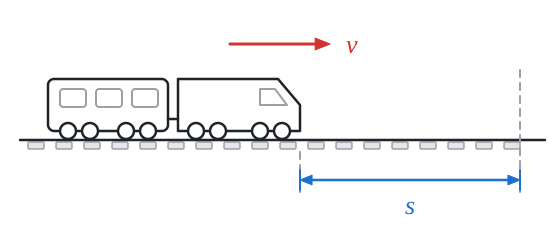
The red arrow is the speed v and the blue dimension line is the distance s that the train has to cover. To each part of the picture we add the letter of the quantity, and possibly the value too. With one train on a straight track the sketch is almost self-evident. But once two cars are driving towards each other, or a train is passing through a tunnel and its length matters, the picture often reveals what is actually going on in the problem sooner than the calculation does.
Letters first, numbers last
We would love to substitute the numbers at once. It is better, though, to solve the whole problem first in general, that is, with letters only, and to substitute the numbers into the finished formula at the end. From the formula s = v · t we express the time by dividing both sides by the speed:
Only now do the converted values come in:
The train covers 1.8 km in 90 s, that is, in a minute and a half.
Why all this ceremony, when we could have divided straight away? With such a short problem the difference is small, but the general solution has several advantages that quickly show up in longer problems:
- From the formula with letters we can tell whether it makes sense. In the formula
- The formula lets us check the units, more on that in a moment.
- When we make a mistake, we know where to look. In a line full of numbers an error hides much better.
- We pick up the calculator only once and round only the result. Why that matters we will see under typical mistakes.
- When the problem changes, say the train goes faster, we just substitute again. We already have the formula.
Do the units fit?
We substituted with the units, and we calculate with them just as with numbers. Metres cancel with metres and dividing by a fraction is the same as multiplying by the inverted fraction:
We got seconds, the unit of the time we are looking for. With kilometres and hours it would turn out the same:
Checking the units also reveals a wrongly rearranged formula. Anyone who swapped the numerator and the denominator and calculated
and that is not a unit of time. We know at once that something is wrong, and we do not even have to calculate anything.
Both routes give the same answer
Let’s run the train once more in kilometres and hours, to convince ourselves that it works:
Here is the mysterious 0.025 from the introduction. This time we know that it is hours, because kilometres divided by kilometres per hour give hours. We convert to seconds by substituting 3,600 s for the hour:
We got the same 90 s. Which route is better? It depends on the problem. In kinematics and dynamics we will almost always convert to metres and seconds, because accelerations and forces are calculated in them too. For travelling by car or train, where everything is in kilometres and hours, it is usually more convenient to stay with them.
Is the result reasonable?
Finally we estimate whether the result makes sense. A speed of 72 km/h means 72 km in sixty minutes, that is 1.2 km a minute. A distance of 1.8 km is one and a half times longer, so it will take the train one and a half times longer than a minute. A minute and a half, that fits. Answer: the train covers 1.8 km in a minute and a half.
Often plain experience is enough. Poppy walks 1.5 km to school and it takes her 18 min. What is her speed? Anyone who divides metres by minutes gets
and if they forget that this is metres per minute and not per second and “convert” to kilometres per hour, they get 83.3 · 3.6 ≈ 300. Poppy would be walking to school at 300 km/h, faster than a high-speed train. A result like that is wrong even if we have no idea where the mistake happened. To do it correctly we convert minutes to seconds, 18 · 60 s = 1,080 s, and get
After multiplying by 3.6 that is roughly 5 km/h, an ordinary walking pace. For a rough check the table of speeds is handy: a pedestrian walks at around 5 km/h, a cyclist at around 20 km/h, a car on a motorway abroad at 130 km/h. A car travelling at 3,000 km/h, or a train that covers a kilometre in three seconds, is a clear signal that it is time to look for a mistake.
The method in a nutshell
We have been through the whole method on a train. Let’s summarise it:
1. Notes. We write out what we know, each quantity with a letter, a number and a unit, and what we are looking for, with a question mark.
2. Converting the units. We convert everything to the same units, usually metres, seconds and metres per second.
3. A sketch. We draw what is happening and add the quantities to the picture.
4. The general solution. We express the required quantity from the formula, with letters only.
5. Substitution. We substitute the numbers, with their units, into the finished formula and calculate the result.
6. Checking the units. We check that the unit of the required quantity came out.
7. An estimate. We ask whether the result is reasonable, and answer the question in the problem in a full sentence.
We will follow the same method in all the further problems, including dynamics. There, forces are added to the quantities and the sketch will be even more important, because we will draw into it which force acts where.
Typical mistakes
Minutes substituted as hours. A pedestrian walks at 5 km/h. How far will they get in 15 min? Anyone who substitutes fifteen straight into s = v · t gets
and because the speed was in kilometres per hour, they write 75 km. In a quarter of an hour the pedestrian would get from London almost to Oxford. The speed is in kilometres per hour, so the time must be in hours. Fifteen minutes is a quarter of an hour, 0.25 h:
We can easily overlook a mistake like this when we substitute numbers without units. With the units we would get kilometres per hour times minutes, and those do not cancel.
Tenths of an hour are not minutes. For example 1.5 h is not one hour fifty, but one hour and thirty minutes, because an hour has sixty minutes, not a hundred. In the same way 0.25 h is not twenty-five minutes, but fifteen. You convert a decimal part of an hour to minutes by multiplying it by sixty:
Rounding intermediate results. Let’s look again at the train calculated in hours. We got 0.025 h. Anyone used to rounding to two decimal places writes 0.03 h and carries on:
Instead of 90 s we got 108 s, which is 18 s more. The error is twenty per cent, and only because of one innocent-looking rounding. We added just five thousandths of an hour, but 0.025 is a small number and five thousandths is a whole fifth of it. After multiplying by 3,600, five thousandths of an hour became 18 s. So do not round intermediate results at all, or at least keep two or three digits more than you want in the result. The surest way is the general solution: we calculate with numbers only at the end and round just once, only the finished result, in the units in which we want it.
A cyclist from start to finish
Finally we will go through one problem in full, step by step. A cyclist is riding along a cycle path at a constant speed of 18 km/h. How long does it take to cover 4.5 km?
We write down what we know and what we are looking for:
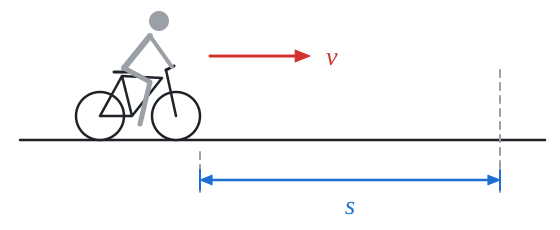
The distance is in kilometres and the speed in kilometres per hour, the units are not mixed, so this time we do not need to convert and the time will come out in hours. As a check we will then also calculate it in seconds. The sketch is almost the same as for the train:
We know the general solution from the train,
The units fit, kilometres divided by kilometres per hour give hours. A quarter of an hour then corresponds to
Now the same in base units. We convert:
and substitute:
A minute has sixty seconds, so
Does the result make sense? In an hour the cyclist would cover 18 km, so in a quarter of an hour a quarter of that, 4.5 km. Exactly as much as they had to cover. We write the answer in a full sentence: the cyclist covers 4.5 km in 15 min.
With the same method we can also manage motion problems, in which two cars meet or one catches up with the other. There the sketch and the general solution really pay off.
