
Worked examples in dynamics
The best way to understand forces is to calculate with them. Here are thirteen examples, from adding forces through Newton’s laws, momentum and friction to a bend and a fictitious force. Three of them (the slide, braking on snow and a train pulling away) link forces with motion: from the forces we work out the acceleration, and from the acceleration a speed or a distance. We keep to the tried and tested method: write down the data, sketch the forces, choose the positive direction, solve in general, substitute with units and give the answer in a full sentence. Draw the sketch yourself; only the first example has a figure. Try every example yourself first.
Example 1: Two tractors and a stuck combine harvester
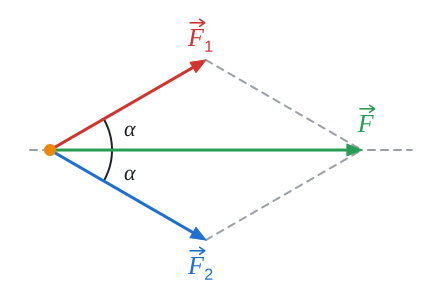
A combine harvester is stuck in the mud. Two tractors are pulling it out, each with a rope and a force of 30 kN. The ropes make an angle β = 60° and the harvester lies exactly on the axis between them. How large is the resultant force?
Solution:
We choose the x-axis along the axis between the ropes, positive in the direction of the pull. Because the harvester lies on the axis, each rope deviates from it by half the angle between the ropes,
Answer: The resultant force is about 52 kN, not 60 kN. Part of the pull is wasted, because each tractor pulls in a slightly different direction. The wider the ropes spread, the greater the loss: at an angle β = 120° between the ropes, α = 60° and the resultant is 2 · 30,000 N · cos 60° = 30,000 N, as if only one tractor were pulling.
Example 2: A motorboat
Thanks to its propeller, a boat of mass 300 kg including its crew is driven forwards by the water with a force of 900 N. The resistance of the water is 300 N. What is the boat’s acceleration?
Solution:
We take the direction of travel as positive. The resistance points against it, so it has a minus sign in the resultant. Then we just add the forces and divide by the mass:
The units fit: a newton per kilogram is a metre per second squared. Answer: The boat’s acceleration is 2 m/s2. The resistance of the water grows with speed, and when it reaches 900 N, the resultant force will be zero and the boat will travel at a steady speed.
Example 3: A lorry and a car
A lorry of mass 10,000 kg hits a car of mass 1,000 kg. Which body exerts the greater force on the other? What accelerations do they have if the force of the impact is 50,000 N?
Solution: Most people would guess the lorry. But the forces of the impact form an action–reaction pair, and so they are equal in magnitude and opposite. The lorry pushes the car with a force of 50,000 N, and the car pushes the lorry with the same force. The difference lies in what the force does to each body.
We take the lorry’s direction of travel as positive:
Answer: The two bodies exert equal forces on each other. The lorry has an acceleration of −5 m/s2, that is, it slows down, while the car gains an acceleration of 50 m/s2, about five times the acceleration due to gravity. That is why the occupants of the car come off worse, even though the forces are equal.
Example 4: Scales in a lift going down
Ryan, who has a mass of 80 kg, is standing on scales in a lift. The lift is going down and, just before the ground floor, brakes with a deceleration of 1.5 m/s2. What will the scales show?
Solution: Upwards will be the positive direction. The lift is going down and slowing, so its acceleration points up: a = 1.5 m/s2.
Ryan is pulled down by his weight and pushed up by the normal force of the scales. By Newton’s second law FN − m · g = m · a, so the normal force comes out just as for a lift that is starting to move up:
The scales divide the force by the acceleration due to gravity and show
Example 5: A rover on Mars
The Perseverance rover has a mass of 1,025 kg. How large is the weight acting on it on Earth, and how large on Mars, where the acceleration due to gravity is 3.71 m/s2?
Solution:
Weight is mass times the acceleration due to gravity. On Mars
and on Earth, by the same calculation with g = 9.81 m/s2,
Answer: On Mars the weight acting on the rover is about 3.8 kN, a little over a third of its weight on Earth, 10 kN. Its mass, though, is the same everywhere, and so for the same force it is just as reluctant to get moving.
Example 6: A tennis serve
A tennis player serves a ball of mass 57 g, which is almost at rest at the top of the toss. The racket is in contact with it for 5 ms and the ball leaves at a speed of 50 m/s. What average force does the racket exert on it?
Solution:
We take the direction of the ball’s flight as positive. The force equals the change in momentum divided by the time over which it acts, that is, the impulse divided by the duration of the impact:
That is about as much as if a person of mass 58 kg were standing on the ball, only for five thousandths of a second. Answer: The racket pushes on the ball with an average force of 570 N. With a contact twice as long, half the force would be enough for the same speed.
Example 7: Hockey players in a clinch
A hockey player of mass 90 kg is skating at 6 m/s and collides head-on with an opponent of mass 80 kg, who is skating towards him at 4 m/s. After the collision they lock together. How fast and in which direction do they move?
Solution: The positive direction is the one in which the first player is skating, so the opponent’s velocity is negative.
On ice friction is small and the collision is short, so we treat the pair as an isolated system. By the law of conservation of momentum, the momentum before the collision is the same as after it:
The result is positive, so the pair slides in the direction in which the player with the greater mass and speed was skating. Answer: They move at about 1.3 m/s in the first player’s original direction. Anyone who forgets the sign gets an absurd 5.1 m/s.
Example 8: A bench in the sports hall
A wooden bench of mass 25 kg stands on a wooden floor. The coefficient of static friction is 0.5 and the coefficient of kinetic friction is 0.3. Will a horizontal force of 100 N set it moving? And what will the bench’s acceleration be if we push it with a force of 130 N?
Solution:
On a horizontal floor the normal force equals the weight, FN = m · g. The maximum static friction is
A force of 100 N is smaller, so the bench stays at rest and the static friction is exactly 100 N. A force of 130 N breaks it free, and it is then held back only by kinetic friction. We take the direction of the push as positive:
Answer: The bench starts moving with an acceleration of about 2.3 m/s2. With a push of 100 N we won’t move it at all.
Example 9: A slide
A child slides from rest down a slide 4 m long, inclined at 30°. The coefficient of kinetic friction between the child’s trousers and the slide is 0.3. How fast is the child going at the bottom?
Solution:
We take down along the slide as the positive direction. The component of the weight along the slope is m · g · sin α, and the friction μ · m · g · cos α points against the motion. After the mass cancels, we are left with the acceleration on a slope with friction, a = g · (sin α − μ · cos α). To get a feel for it, it comes out at about 2.36 m/s2.
We don’t know the time, so the speed at the bottom comes from the relation without time, v2 = 2 · a · s. We substitute the acceleration into it in general form:
Answer: The child reaches the bottom at about 4.3 m/s, which is just under 16 km/h. Without friction it would be over 6 m/s.
Example 10: A cyclist on a bend
What is the greatest speed at which a cyclist may take a horizontal bend of radius 12 m on dry tarmac with a coefficient of friction of 0.7? And how fast on wet tarmac with a coefficient of 0.5?
Solution:
The cyclist is held on the circle only by the friction of the tyres, which points towards the centre of the bend. That must be enough for the centripetal force,
That is about 33 km/h. On a wet road the same calculation gives 7.7 m/s, just under 28 km/h. Because the mass cancelled, a cyclist of greater mass has it neither easier nor harder. At a higher speed the wheels slide out of the bend.
Example 11: A crate in a braking van
A wooden crate of tools of mass 30 kg lies on the wooden floor of a van, and the coefficient of static friction is 0.5. The driver brakes with a deceleration of 6 m/s2. Assess the situation from inside the van: does the crate slide forwards?
Solution: The van is braking, so it is a non-inertial frame. In it, an extra fictitious force acts on the crate, opposite to the van’s acceleration, that is, forwards. We take forwards as the positive direction.
The van’s acceleration points backwards, and so it is negative. The fictitious force and the maximum static friction:
The fictitious force came out positive, so it points forwards. Answer: Friction will not hold the crate, and it slides forwards. It would hold it only up to a deceleration of μs · g ≈ 4.9 m/s2, and the mass cancels. From outside the situation looks the same, only without the fictitious force: for a deceleration of 6 m/s2 the crate would need a friction of 180 N, but static friction gives at most 147 N. The crate therefore decelerates less than the van.
Example 12: Braking on snow
A car is driving along a snowy road at 45 km/h and the driver brakes so that the wheels lock. The coefficient of kinetic friction between the tyres and the snow is 0.3. How long is the braking distance, and how long does the braking take?
Solution:
The direction of travel will be positive. Only friction slows the car,
Answer: The car stops after 26.5 m, and the braking takes over four seconds. On a dry road with a coefficient of 0.7, 11.4 m would be enough. The mass does not appear in the formula, so even a fully loaded car brakes in the same way, at least in this simplification.
Example 13: A train pulling away
A train of mass 400 t pulls away from a station. The rails push the train forwards through the locomotive’s wheels with a force of 200 kN, and the resistance to motion is 40 kN. How long does it take, and over what distance, to reach a speed of 90 km/h, if the forces do not change?
Solution:
We take the direction of travel as positive. First the dynamics, Newton’s second law:
Then the kinematics of uniformly accelerated motion from rest, and the relation without time:
Check: the average speed is 12.5 m/s, and in 62.5 s that gives the same 781 m. Answer: The train needs about a minute and just under a kilometre. In reality the resistance grows with speed, and so pulling away takes somewhat longer.
The end of the journey
This is where the textbook on kinematics and dynamics ends. We began with what a quantity and a unit even are, went on through speed and acceleration to forces and Newton’s laws, and finally combined the two: the force tells us how large the acceleration is, and the acceleration tells us where and how fast the body gets to. With this pair you can manage most problems about motion and forces. Work and energy will come later.
