
Inclined plane
Alfie puts his sledge on a snowy hill and lets go. The sledge sets off and picks up speed on the way. Only the Earth is pulling it down, and the weight points straight down, not at an angle along the slope. So why doesn’t the sledge fall straight to the ground instead of running along the hill? And why does it slide down a gentle slope more slowly than a steep one? One trick explains both: we resolve the weight into two components.
A slope, a slide, a ramp or a slanting plank are all called an inclined plane in physics. How steeply it is inclined is given by the angle α that it makes with the horizontal ground.
Resolving the weight
We replace the weight
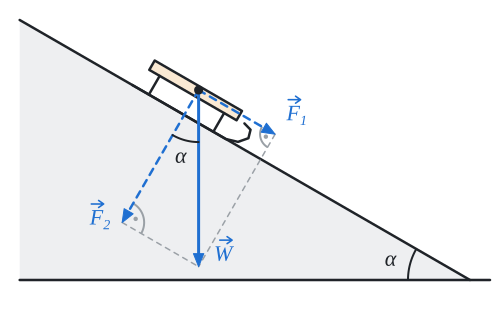
The blue dashed component
What are the magnitudes of the components? The weight, the component
We multiply both equations by the weight:
That leaves the promised explanation. The weight is perpendicular to the horizontal ground, and the component
If you don’t like rotating, you can calculate instead. Let’s extend the weight vertically down to the ground. The vertical, the ground and the slope form a right-angled triangle with the angle α at the bottom by the ground, so at the slope it has the angle 90° − α. The perpendicular to the slope makes a right angle with the slope, so it deviates from the vertical by 90° − (90° − α) = α.
We can check that this is right on the extreme cases. On horizontal ground, α = 0°, sin α = 0 and cos α = 1. The component along the slope disappears and the whole weight presses on the surface, exactly as it should. The steeper the slope, the greater the sine and the more strongly the sledge is pulled down. That is the answer to the second question.
Let’s try it with Alfie’s sledge of mass 10 kg on a slope inclined at 30°. The weight is
We substitute sin 30° = 0.5 and cos 30° ≈ 0.866:
Careful: 49.05 N + 85 N is not 98.1 N. That’s because we add the components as arrows, not as numbers.
In an exam it often happens that someone swaps sine and cosine. You don’t have to remember which goes where, you just have to think of horizontal ground. There the component along the slope must vanish, and it is the sine, not the cosine, that gives zero at 0°. So the component along the slope is the one with the sine.
The normal force on a slope
The snow acts on the sledge with a normal (contact) force
On a slope, the normal force is smaller than the weight. For Alfie’s sledge it is 85 N, not 98.1 N. This is where mistakes are most often made in exams: if you carry over FN = m · g from a horizontal floor, you get the friction wrong on a slope too.
The steeper the slope, the smaller the cosine, the more weakly the sledge presses on the snow and the smaller the friction. For a vertical wall, cos 90° = 0 and the normal force disappears altogether.
A sledge without friction
Let’s begin with a perfectly smooth slope, say a sledge with steel runners on ice. We ignore air resistance. The normal force cancels the component
We divide by the mass:
The mass has cancelled. An empty sledge and a sledge with Alfie on it would accelerate equally down a smooth slope, just as light and heavy bodies fall with the same acceleration. A sledge with a greater mass is pulled down by a greater force, but it is harder to get moving in exactly the same proportion.
For a slope inclined at 30°:
Exactly half of the acceleration due to gravity. The extreme cases fit too: on horizontal ground sin α = 0 and the sledge will not start moving by itself, and for a vertical wall sin 90° = 1 and a = g, which is free fall.
A sledge with friction
On real snow, though, the sledge is slowed by friction. The frictional force
For runners on packed snow, we take μ = 0.1. Steel or plastic runners slide over snow much better than, say, rubber. Alfie’s sledge is slowed by a force of
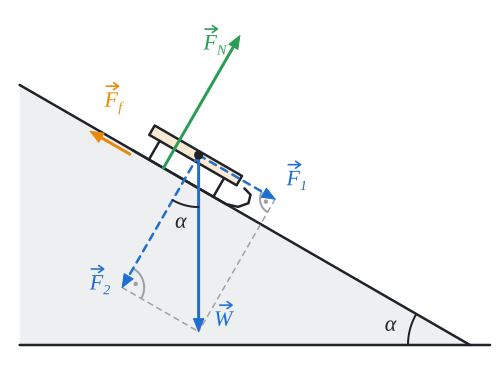
The resultant force along the slope is the component F1 reduced by the friction, about 49.05 N − 8.5 N ≈ 40.6 N, and the acceleration is
In general, Newton’s second law along the slope reads
and when we divide the equation by the mass, we get the formula for the acceleration on a slope with friction:
Here too the mass has cancelled. Substituting 9.81 m/s2 · (0.5 − 0.1 · 0.866) gives 4.06 m/s2 again.
On a gentler slope inclined at 10°, sin 10° ≈ 0.174 and cos 10° ≈ 0.985, so
The angle is three times smaller, but the acceleration is more than five times smaller. Here friction takes most of the component along the slope. And on a slope inclined at 5° the bracket would come out negative: a sledge that was already moving would slow down until it stopped. Why it then stays at rest is explained in the next section.
When a body stays at rest
Alfie and his little brother pull the sledge back up and rest for a while on a gentler part of the path. The sledge stands there and doesn’t slide down. It is held by static friction, which is always exactly large enough to balance the force pulling the sledge down, here the component F1. At most it can be μs · FN, where μs is the coefficient of static friction. So the sledge stays at rest as long as
The ratio of the sine to the cosine is called the tangent,
Whether a body on a slope slides down is decided not by its mass but only by the angle and the surface. To get the angle back from a known tangent, use the tan−1 button on a calculator.
On a slope inclined at 5°, tan 5° ≈ 0.087, which is less than 0.1, and static friction is even greater than kinetic friction. A sledge that has stopped there will therefore not start moving again by itself. The formula with a negative acceleration only describes the sledge while it is moving downhill.
This suggests a simple experiment. Stand a wooden building block on a board and slowly raise one end. For wood on wood, μs ≈ 0.5, so the block starts to move when tan α reaches 0.5, which is at roughly 27°.
It is the same with a parked car with its brakes on. On dry tarmac, even a very steep street will hold it. But the coefficient of static friction on an icy road is only about 0.1, and tan α = 0.1 corresponds to a slope of just under 6°. You can find a hill like that in almost every town, and a car will slide down it on ice whether it is light or heavy.
Kinetic friction is smaller than static friction. On a slope of around 20°, the block therefore stays at rest by itself, but after a tap it sets off and keeps accelerating, because tan 20° ≈ 0.36 is more than the kinetic μ = 0.3.
An exam question step by step
A crate of apples of mass 20 kg lies on a wooden plank that slopes from the back of a lorry down to the ground. The plank is 2 m long and makes an angle of 35° with the ground. The coefficient of kinetic friction for wood on wood is 0.3, and the coefficient of static friction is 0.5. Will the crate start to slide by itself? What will its acceleration be, and how fast will it be moving when it reaches the ground?
Given: m = 20 kg, α = 35°, s = 2 m, μ = 0.3, μs = 0.5, g = 9.81 m/s2. Find: a and v. The units are base units, so we have nothing to convert.
Draw the forces. They are the same as for the sledge.
Will it start to slide? tan 35° ≈ 0.70 is more than μs = 0.5. Static friction cannot hold the crate.
Resolve the weight. To get a feel for the numbers: W = m · g = 196.2 N, sin 35° ≈ 0.5736 and cos 35° ≈ 0.8192. Along the plank the crate is pulled by F1 ≈ 112.5 N, and it is pressed into the plank by F2 ≈ 160.7 N. From here on, though, we calculate with letters and substitute the numbers only at the end.
Add up the forces along the plank. Perpendicular to the plank the forces balance, so FN = m · g · cos α and the frictional force is Ff = μ · m · g · cos α. Along the plank, F1 pulls down and friction pulls up:
Express the acceleration. After dividing by the mass:
The speed at the bottom. The crate starts from rest and accelerates uniformly, so v2 = 2 · a · s and
Substitute. We leave the acceleration unrounded in the calculator:
Check: the acceleration is smaller than g · sin 35° ≈ 5.6 m/s2 without friction, as it should be.
Answer: The crate starts to slide by itself, accelerates at about 3.22 m/s2 and reaches the ground at a speed of about 3.6 m/s, almost 13 km/h. For the apples’ sake, someone had better catch it at the bottom.
On an inclined plane, then, it is enough to resolve the weight and carry on as on horizontal ground: balance perpendicular to the surface, Newton’s second law along it. So far, though, all the bodies have moved in a straight line.
What it takes for a sledge or a car to turn is shown in the next article, Centripetal force.
