
Free fall
Drop a set of keys and a sheet of paper from your hand at the same time. The keys clink on the floor almost immediately, while the paper sways through the air for a while. So do heavier things fall faster? That is just what most scholars believed for almost two thousand years, starting with Aristotle. Only around the turn of the 17th century did Galileo Galilei realise that the difference is made by the air. If there were none, a stone, a hammer and a bird’s feather would fall equally fast.
According to legend, Galileo proved it to his students by dropping two balls of different weights from the Leaning Tower of Pisa. It is a nice story, but we know it only from his pupil and biographer, and historians doubt that it really happened. Galileo actually worked it out by more patient experiments, which we will come to shortly.
The hammer and the feather on the Moon
On Earth it is hard to demonstrate, because there is air all around us. On the Moon, though, there is none. In 1971 the astronaut David Scott of the Apollo 15 mission dropped a geological hammer and a falcon feather from the same height in front of a television camera. The feather was not chosen at random: the mission’s lunar module was called Falcon. Both fell equally fast and both hit the dust at the same instant. Scott added drily that Mr Galileo had been right.
On the left is the Moon, on the right, for comparison, the Earth with air.
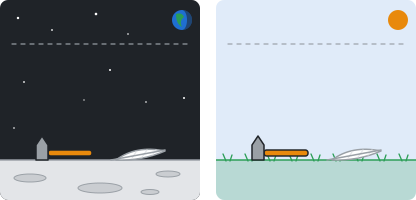
The motion of an object that we release from rest and which then falls only because the Earth (or the Moon) attracts it, with no air resistance at all, is called free fall. On the Moon feathers and hammers fall in free fall. On Earth a falling stone, keys or an apple come very close to it, at least as long as they are not falling from a great height. Neither a feather nor a sheet of paper is in free fall; the air slows them down far too much.
Falling with acceleration g
Galileo discovered one more thing. The speed of a falling object increases uniformly, by the same amount every second. Free fall is therefore uniformly accelerated motion from rest. Its acceleration is the same for all objects at one place, it is called the acceleration due to gravity and is denoted g. It sounds odd, since a hammer is much heavier than a feather. The Earth does attract it more, but it also resists being set in motion more, and the two effects cancel out exactly. Why this is so will only become clear when we look at forces. Where we live,
A freely falling stone is going 9.81 m/s faster every second. The exact value differs a little from place to place: at the equator the acceleration due to gravity is about 9.78 m/s2, at the poles 9.83 m/s2. For a mental estimate 10 m/s2 is enough. On the Moon it is roughly six times smaller, so Scott’s hammer and feather fell noticeably more slowly than a stone on Earth.
An object falls along a vertical line, so we choose downwards as the positive direction. The acceleration and the velocity then come out positive. The formulas of uniformly accelerated motion v = v0 + a · t and
We measure the time t from the moment of release, v is the speed at that moment and h is the height by which the object has dropped in that time. During the first second the stone reaches a speed of 9.81 m/s and falls 4.9 m. After two seconds it is going at 19.6 m/s and has fallen 19.6 m, after three it is going at 29.4 m/s and is already 44.1 m below the place from which we released it.
You might be tempted to calculate the height as speed times time. But the stone reaches a speed of 19.6 m/s only at the end of the second second; before that it was falling more slowly, and the result would come out twice as large. That is exactly why there is a half in the formula.
Marks after equal times
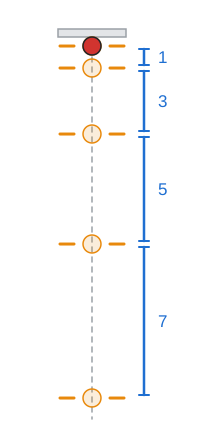
In the picture a ball is falling, in slow motion so that there is something to see, and after every equal interval of time, say a tenth of a second, it leaves an orange mark behind. The marks get further and further apart, because the ball is faster with every moment. In one unit of time the ball drops by one unit of distance, in two units of time by 22 = 4 units, in three by 32 = 9 and in four by 42 = 16 units. The sections between the marks are then 1, 4 − 1 = 3, 9 − 4 = 5 and 16 − 9 = 7 units long. Neighbouring squares differ by odd numbers.
Free fall was too fast for the clocks of the time, so Galileo let balls roll down a gently sloping channel, where everything happens more slowly. He found exactly these odd numbers, 1 : 3 : 5 : 7.
How deep is the well?
At your cottage you have an old well and you want to know how far down the water is. You drop a stone into it and use a stopwatch to measure that it splashes after 2 s. First we write down what we know about the fall:
The stone falls from rest, so we substitute straight into the formula for height:
The seconds squared cancel and metres are left. The water lies about 19.6 m below the rim of the well, which is quite a depth. As a quick check we take, rounded, g ≈ 10 m/s2: half of ten times four is twenty metres. It agrees.
We have neglected the time the sound of the splash needs to travel back up. Sound covers twenty metres in roughly six hundredths of a second, which barely shows against two seconds. Nor does air resistance slow the stone much over twenty metres.
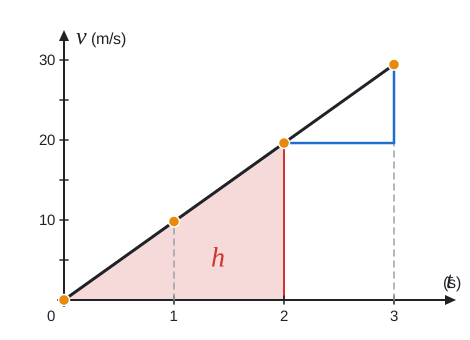
In the graph the speed of the stone forms a straight line that rises by 9.81 m/s every second. Its slope is the acceleration due to gravity g. We find the distance as the area under the graph, here as the red right-angled triangle with sides 2 s and 19.6 m/s next to the right angle. Its area is
A jump from the ten-metre tower
The highest diving platform is ten metres above the water. How long does a diver fall and at what speed does she hit the water? In reality she pushes off the platform and spins in the air, but we will simplify things: she simply falls from rest like a stone.
This time we know the height and are looking for the time, and we have to express it from the formula for height. First we multiply both sides by two, which makes the fraction disappear. Then we divide them by the acceleration due to gravity, and only the time squared is left on the right-hand side:
So far we have the time squared, but we need the time itself. A square root helps: we take the square root of both sides. We are not interested in the negative result, since the time from release is positive:
Substituting:
The metres cancel and the seconds squared move from the denominator to the numerator. Their square root then gives seconds. The impact speed comes from the formula for speed:
The diver falls for under a second and a half and hits the water at about 14 m/s, that is roughly 50 km/h. That is how fast cars drive through towns.
The impact speed can also be found without the time. From the relationship
Beware of one trap. From twice the height the diver does not fall for twice as long. The height is under the square root in the formula, so from twenty metres she would fall for only about 2.02 s. This agrees with the well: in two seconds the stone fell just under twenty metres.
The same formula also serves for an amusing experiment. A friend holds a ruler vertically and you have your thumb and forefinger open around its lower end. Your friend lets go of it without warning and you catch it as fast as you can. If the ruler manages to drop by 20 cm, it fell for
Air resistance and the skydiver
If there were no air, after fifteen seconds of falling a skydiver would be going at v = 9.81 m/s2 · 15 s ≈ 147 m/s, more than 500 km/h, and would keep accelerating. But a skydiver never falls that fast, because the air resists a falling object, and the faster it moves, the more.
Straight after jumping from the aircraft the skydiver is slow, the air resistance is small and he falls almost in free fall. But the resistance grows with speed, the speed increases more and more slowly, until it stops growing altogether. The skydiver then falls at a constant speed called the terminal velocity. Spread out face down, he reaches roughly 200 km/h. An open parachute greatly increases the resistance and the speed drops to a few metres per second, slow enough to land safely.
Air is also useful when it rains. A drop from a cloud at a height of two kilometres would, without air resistance, hit the ground at
A feather and a sheet of paper have a very small terminal velocity, they reach it almost at once, and that is why they float down so slowly. Why shape and mass matter so much will be shown by dynamics. A stone dropped into a well or a diver from a tower reach speeds of at most around seventy kilometres per hour, at which the air resistance is still small, so the free fall formulas fit well.
Free fall calculator
Enter the fall time and the calculator tells you the height from which the object fell and the speed at which it landed. It uses g = 9.81 m/s2 and no air resistance.
And the other way round: enter the height and the calculator works out how long the object falls and at what speed it lands.
A falling stone performs a single motion, vertically downwards. Often, though, an object performs several motions at once: a boat heading for the opposite bank is carried along by the current, and raindrops that fall vertically fly diagonally past a moving car. Where the boat ends up, and how it has to aim to land directly opposite, we will work out in the next article, Combining motions.
