
Braking and braking distance
You are driving through a town at 50 km/h and twenty metres in front of you a child runs out from between parked cars after a ball. Will you stop? The car does not stop at the moment you see the child. First you have to react and press the brake, and only then does the car start to slow down. The distance from seeing an obstacle to stopping therefore has two parts:
- the thinking distance (reaction distance) sr, which the car covers before the driver starts braking,
- the braking distance sb, which it covers from pressing the brake to stopping.
The subscript r stands for reaction and b for braking. Together they give the total stopping distance:
Thinking distance
Before the driver reacts to an obstacle, the reaction time tr passes. The driver has to notice what is happening, decide, move a foot from the accelerator to the brake and press it. A rested and alert driver manages this in roughly 1 s, so one second is a convenient round figure to calculate with. A tired driver, or one who is just answering a message, reacts much more slowly. Someone who glances at a phone for two seconds at 50 km/h travels almost 28 m blind.
During the whole reaction time the speed of the car does not change, because the driver is not braking yet. The thinking distance is therefore the distance travelled in uniform motion:
We convert fifty kilometres per hour to metres per second,
Almost fourteen metres, and the car has not even started to brake.
Braking distance
As soon as the driver presses the brake, the car begins to slow down. A good car on dry tarmac brakes with a deceleration of roughly 7 m/s2: every second it is travelling 7 m/s slower. We take the direction of travel as the positive direction, so the acceleration comes out negative, a = −7 m/s2. Let’s assume that it does not change during braking. Braking is then uniformly accelerated motion with a negative acceleration, which is also called uniformly decelerated motion.
Braking starts at the velocity v at which the car was travelling and ends at zero velocity. We are not interested in the time, so we reach for the relationship without time,
The minus sign in the formula need not alarm us. The acceleration is negative, so the denominator is negative too and the whole fraction comes out positive, as a distance should. The minus sign and the negative value of a give a positive number, the deceleration. We denote it by the magnitude of the acceleration
We substitute the numbers into the formula. We leave the speed as a fraction so that we do not round an intermediate result:
The units work out: metres squared per second squared divided by metres per second squared give metres. From 50 km/h the car stops in 13.8 m, almost as far as it travelled during the reaction time.
It is tempting to substitute the speed straight away in kilometres per hour. We would get
How long does braking take? From the formula v = v0 + a · t with a final velocity of zero we get, by the same reasoning,
From pressing the brake to stopping, just under two seconds pass.
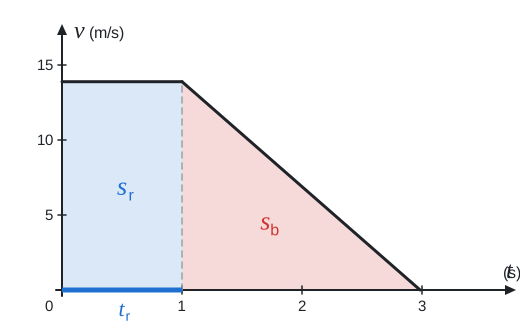
The whole motion is shown by the velocity graph. During the reaction time tr it is horizontal: the car travels at a constant speed. Then it falls along a straight line to zero. The distance is the area under the graph: the blue rectangle is the thinking distance, the red triangle the braking distance. The area of the triangle is half the product of the two sides that form the right angle,
Will we stop before the child?
We work out the whole distance step by step. First the data, converting the speed straight away to metres per second:
In general the stopping distance is the sum of the two parts:
We have already calculated both parts:
From the moment you see the child, the car travels about 28 m, roughly six car lengths. You will not manage to stop before a child who ran out twenty metres in front of you. By the time you reach the child, you will have been braking for only six metres after the reaction time and will still be travelling at almost 40 km/h.
Twice the speed, four times the braking distance
And what if you were driving at 100 km/h on a main road? The speed is 100 km/h ≈ 27.8 m/s. In one second of reaction time you cover 27.8 m, twice as much as from 50 km/h. The braking distance is
four times as much as from 50 km/h. In total the car covers 27.8 m + 55.1 m ≈ 83 m, three times as much as from 50 km/h.
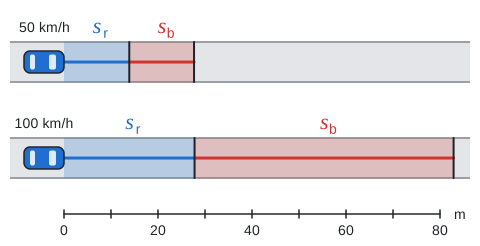
Why exactly four times? In the formula for the braking distance the speed is squared, and twice the speed squared is four times as much: (2 · v)2 = 4 · v2. The thinking distance grows with speed only in direct proportion, so the faster you drive, the larger the part of the stopping distance that is braking. On a motorway abroad at 130 km/h a car covers 36 m during the reaction time and then brakes for another 93 m. From seeing an obstacle to stopping it therefore needs almost a hundred and thirty metres, more than a whole football pitch.
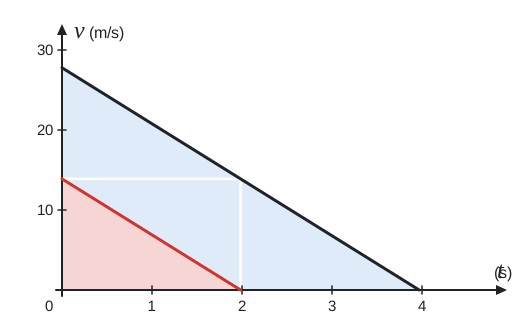
In the graph it is even easier to see. Here we measure the time from pressing the brake. From 100 km/h the graph starts twice as high, and because the speed is lost at the same rate, 7 m/s every second, braking also takes twice as long. The triangle is twice as tall and twice as wide, so its area is four times as large. The white lines, together with the red one, divide it into four triangles, each congruent to the red one.
A 30 km/h limit outside a school
Near schools the speed limit is often lowered to about 30 km/h. Does that make sense when it is only twenty kilometres per hour less? From 30 km/h, that is from 8.3 m/s, the car covers 8.3 m during the reaction time and the braking distance is
The car stops after 13.3 m. A driver travelling at 50 km/h covers 13.9 m in the reaction time alone. Where the driver doing 30 km/h would already be standing still, the other has not even started to brake yet and hits the child at the full 50 km/h.
How big a gap?
On a country road you are driving at 90 km/h, that is 25 m/s, behind another car, which suddenly brakes hard. If both cars brake equally, they also have the same braking distance. But you start braking a reaction time later, and in the meantime you cover 25 m at full speed. The gap must therefore be at least as large as the thinking distance, otherwise you will hit the car in front.
Driving instructors recommend the two-second rule: when the car in front passes a fixed point, such as a road sign, you should reach it no sooner than two seconds later. At 90 km/h that is 50 m, twice the thinking distance. The margin comes in handy, because your brakes may be worse and the car in front may be stopped by an obstacle in much less than its braking distance.
How fast was it going?
The formula also works the other way round. An older car without ABS locks its wheels under hard braking and leaves a black skid mark on the road. After an accident on a dry road the police measure a mark 25 m long. The driver claims he was doing the legal 50 km/h. Is he telling the truth? The data are:
We express the speed from the formula for the braking distance. We multiply both sides by
Substituting:
The square root of metres squared per second squared gives metres per second. The car was doing at least roughly 67 km/h, nowhere near 50 km/h. From 50 km/h the mark would have been only 13.8 m long.
Wet roads and ice
On a wet road, on snow and on ice a car decelerates less, because the tyres grip a slippery surface less well. The reason is friction, and we will come to that when we reach forces. For now it is enough to know that the deceleration is smaller. In the formula it is in the denominator, so half the deceleration means twice the braking distance. Approximate values and the braking distances from 50 km/h:
| surface | sb (m) | |
|---|---|---|
| dry tarmac | 7 | 13.8 |
| wet tarmac | 5 | 19.3 |
| snow | 3 | 32.2 |
| ice | 1 | 96.5 |
On ice you stop from 50 km/h only after almost a hundred metres. The thinking distance is not affected by the surface, because it depends only on the speed and on the driver. That is exactly why people drive more slowly and leave a bigger gap in winter.
Braking distance calculator
Enter the speed, the reaction time and the road surface, and the calculator works out the thinking distance, the braking distance, the stopping distance and the time from seeing the obstacle to stopping. The deceleration for each surface corresponds to the table above and is only approximate; with worn tyres or poorer brakes it will be smaller.
When braking, the speed falls uniformly. We meet the opposite case every day; you only need to drop something: a falling stone gains the same amount of speed every second. How deep a well is if a stone splashes after two seconds, and why a hammer and a feather land on the Moon at the same time, we will work out in the next article, Free fall.
