
Motion and rest
Imagine you are sitting on the train from London to Nottingham, reading. Are you moving? The person sitting opposite would say no. You have been sitting in the same place all the way, a metre from them, and you have not moved once. But a woman standing on the platform at Wellingborough would claim that you are flying past her at a speed of 160 km/h. And both of them are right.
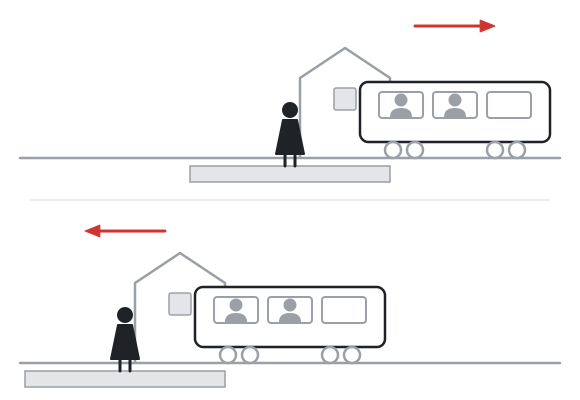
At the top we look at the train from the platform, at the bottom from the carriage. Both red arrows show the same motion, only seen from a different place each time.
Anyone who has ever sat in a stationary train at a station knows this illusion: the train at the next platform slowly pulls away and for a moment it seems to you that you are the one pulling away. Only when you look at the station building do you find that you are standing still. The eye simply needs something to which it can relate the motion.
Frame of reference
Whether a body is moving or at rest cannot be decided on its own. We always have to add relative to what. The body relative to which we judge the motion is called the reference object. For the neighbour on the train it is the carriage, for the woman on the platform it is the Earth.
A body is at rest if it does not change its position relative to the reference object. Relative to the carriage you are at rest, relative to the Earth you are moving. The woman on the platform, on the other hand, is standing still relative to the Earth, but relative to you she is moving away backwards at 160 km/h. Both motion and rest are relative, that is, they depend on where we are looking from.
To describe a position with numbers, we attach a coordinate system to the reference object. We choose a point called the origin and draw the x and y axes from it, as when you draw a graph in maths. At a station the origin could be, say, at the signaller’s box, the x-axis along the tracks and the y-axis perpendicular to them. The position of a body is then given by two numbers: how far it lies in the direction of one axis and how far in the direction of the other. On the train we choose the origin, for example, at the carriage door. The reference object together with the coordinate system and a clock that measures time is called a frame of reference.
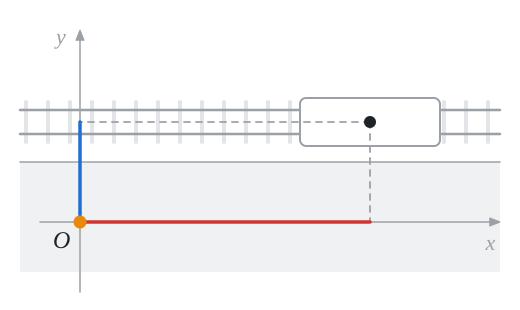
Your position in the carriage, the black dot, is thus determined by the red distance along the x-axis and the blue distance along the y-axis.
In everyday life the frame of reference is almost always the Earth, which is why we often do not even mention it. When we say that a car is travelling at 90 km/h or that a house is standing still, we mean relative to the Earth. But even a “motionless” house is not completely at rest. The Earth rotates about its axis, so in a day a house in Britain traces out a circle about 25,000 km long. In an hour it therefore covers over 1,000 km. On top of that the Earth orbits the Sun at about 30 km/s. By the time you finish reading this sentence, you will have flown some hundred and fifty kilometres with the Earth, the house and the sofa. And even the Sun is not at rest, it orbits the centre of the Galaxy. A body at rest “for real”, that is, without saying relative to what, simply does not exist.
Point particle
A car on the M1 between London and Nottingham is about 4.5 m long. The whole route measures roughly 205 km. If you drew the whole motorway on paper as a line 20 cm long, the car in that picture would measure about 4 µm, sixteen times less than the thickness of a hair. If we want to know when the car will arrive in Nottingham, it does not matter how long it is, where its steering wheel is or whether it has a window open. We can imagine it as a single point moving across a map.
Such a simplification is called a point particle. It is a body whose dimensions we can neglect in the given situation. We replace it with a point that keeps the mass of the whole body. In physics it is much easier to calculate with point particles than with real bodies, which can rotate, bend or change shape.
Whether we may treat a body as a point particle is not decided by the body itself, but by the question we are asking. When parking, the same car is not a point particle. There its dimensions are exactly what matters: whether it fits between two other cars and how many centimetres are left to the kerb. The Earth, on the other hand, is a point particle as it orbits the Sun. Its diameter, about 12,700 km, is negligible compared with the distance to the Sun, 150,000,000 km. But when we are interested in the alternation of day and night, we have to take into account that it is a rotating sphere, and it cannot be replaced by a point.

On the long journey on the left it is enough to replace the car with a point, but when parking on the right its dimensions matter.
Path
The line that a point particle traces as it moves is called its path (or trajectory). Sometimes we can even see it: an aeroplane high in the sky leaves behind a white vapour trail, a skier leaves a track in the snow. A path can be a straight line, a circle or any other curve.
Just like motion and rest, the path depends on the frame of reference. Let’s look at the valve on the front wheel of a bicycle. When a cyclist looks down at the front wheel while riding, they see the wheel spinning on the spot and the valve going round and round. Its path is a circle. A friend who stands on the pavement and watches the cyclist ride past, however, does not see any circle. The wheel rolls forwards, the valve moves forwards with it, and so it draws a series of arches.
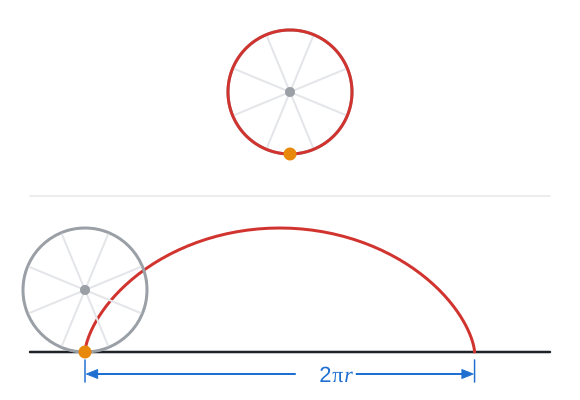
At the top of the picture is the wheel from the cyclist’s point of view, that is, in the frame of reference attached to the frame of the bicycle. The orange valve goes round the red circle. At the bottom is the same wheel in the frame of reference attached to the ground. The grey dashed circle shows where the wheel was when the valve was at the bottom, by the road. Before the wheel turns once, the valve draws a red arch. Both halves of the picture show the same motion of the same valve, just from the point of view of two different frames of reference. The animation shows it step by step: the wheel at the top turns while the one at the bottom also rolls, and the valve draws both tracks at the same time.
The curve that the valve draws from the pavement is called a cycloid. It has its points at the bottom, where the valve touches the road. The wheel does not slide along the road, it rolls along it, so the place that is touching the ground is momentarily at rest. The valve stops there and immediately starts to rise, at first almost vertically upwards. Strictly speaking, the valve sits on the rim a few centimetres closer to the centre than the surface of the tyre, so it does not touch the road and its curve has just a sharp bend at the bottom instead of points. An almost exact cycloid would be drawn, for example, by a pebble stuck in the tread of the tyre.
How far does a wheel go in one turn? If it does not slide, its whole circumference unrolls along the road like a metre from a tape measure. The circumference of a circle with radius r is 2π · r, where π ≈ 3.14, so in one turn the centre of the wheel moves exactly 2π · r. The wheel of a bicycle has a circumference of a little over 2 m, so over a kilometre it makes almost five hundred turns.
The same principle applies on the train. If the train is travelling at a constant speed along a straight track and you drop an apple in the carriage, it falls right to your feet, vertically downwards. The woman on the platform sees it fall and at the same time move forwards with the train, so for her it flies along a slanting arch.
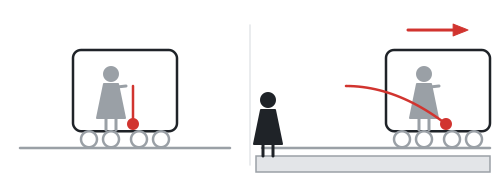
On the left is the fall of the apple as you see it in the carriage, on the right as the woman on the platform sees it.
Distance
The length of the path that a body travels is called the distance and is denoted s. Distance is a scalar, that is, a number with a unit. It is measured by the odometer in a car: it adds every metre the car covers, whether it is going straight, turning or reversing. Distance therefore never decreases with time. When you get back home, nobody subtracts the kilometres you have walked.
Displacement
The hiker Harry set out from a cottage, walked 3 km east and then 4 km north. In all he walked 7 km, but he was only 5 km from the cottage. The arrow from the place where he started to the place where he finished is his displacement. Now we can name both quantities precisely: the distance was 7 km, the magnitude of the displacement 5 km.
Displacement is conveniently written using vectors. We describe the position of a body in a frame of reference by an arrow leading from the origin to the place where the body currently is. That arrow is called the position vector and is denoted
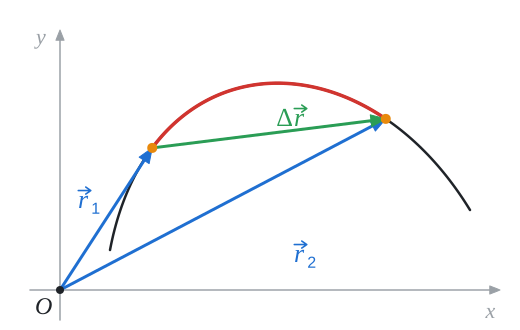
The black line in the picture is the path and the two places through which the body passed one after the other are marked in orange. The blue arrows are position vectors:
Displacement says by how much the position has changed. We denote a change of a physical quantity with the capital Greek letter Δ (delta) in front of its symbol, so displacement is written
It is read “delta r” and the whole thing is a single symbol, not a product. Why a change? Look at the picture. The blue arrow
We subtract
Displacement is the difference between the final and the initial position. If we put the origin O somewhere else, both blue arrows would change, but the green one would stay the same. So displacement does not depend on where we choose the origin, only on where the body started and where it finished. We write the magnitude of the displacement, that is, the length of the green arrow, as
There are two differences between distance and displacement. Distance is a scalar, displacement is a vector, which also has a direction. And distance counts the whole journey, whereas displacement counts only the start and the end. Whether Harry took a detour or turned back three times for a forgotten phone, the displacement stays the same. The shortest link between two points is a line segment, and so the magnitude of the displacement never exceeds the distance,
A lap of the field
A running track in the shape of a circle, 400 m long, goes round the school field. Isla sets off from the start and runs the whole lap. What distance did she cover and what is her displacement?
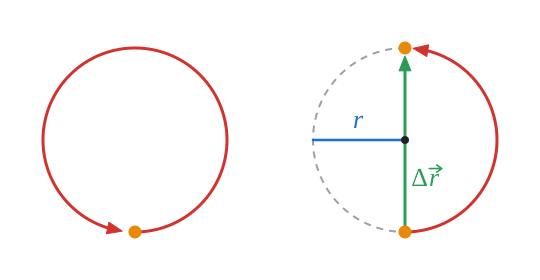
The distance is clear, the whole path is 400 m long, so s = 400 m. But Isla ran exactly to the place she started from. The beginning and the end coincide, and an arrow from a point to the same point has no length. It is the zero vector:
Isla has run four hundred metres and yet her displacement is zero. If she had not moved from the start at all, the displacement would have come out the same. So never confuse distance with displacement.
Now Isla runs only half a lap. The distance is half of 400 m, that is, s = 200 m. Isla has ended up on the other side of the circle, exactly opposite the start. The green displacement arrow goes through the centre of the circle, so its length is the diameter, that is, twice the radius r. We find the radius from the circumference. The circumference of the circle is 2π · r and we know it measures 400 m:
The magnitude of the displacement is twice the radius. The two in the numerator cancels with the two in the denominator:
For π we substitute approximately 3.14:
After half a lap Isla is about 127 m from the start, although she has run 200 m. The radius of the track, incidentally, is half of that, about 63.7 m.
And what about a quarter of a lap? The distance is a quarter of 400 m, that is, s = 100 m. This time the displacement does not go through the centre, but slantwise.
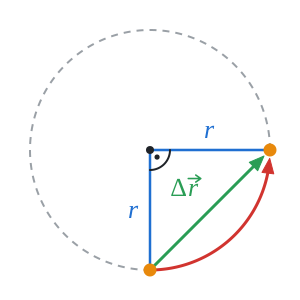
We join both the start and Isla’s new position to the centre of the circle. The two blue radii are perpendicular to each other, because Isla has run a quarter of the circle, and together with the displacement they form a right-angled triangle. The radii are its legs and the displacement is the hypotenuse. We use Pythagoras’ theorem as in Harry’s walk:
We take the square root. The square root of r2 is r, so
We substitute the radius 63.7 m and
All three cases together:
| section | s | |
|---|---|---|
| quarter of a lap | 100 m | 90 m |
| half a lap | 200 m | 127 m |
| whole lap | 400 m | 0 m |
While the distance keeps growing, the magnitude of the displacement first grows and then falls again to zero. Isla is farthest from the start halfway round the lap and at the end she is back at the start.
Types of motion
Motions are classified from two points of view. The first is the shape of the path. When the path is a straight line, we speak of rectilinear motion. This is how a lift or an apple falling from a tree moves. When the path is curved, it is curvilinear motion. Among curvilinear motions the most important is motion in a circle, for example on a carousel or at the tip of the hand of a clock.
The second point of view is how fast the body moves. When it covers the same distance in equal intervals of time (the same in every second, but also in every tenth or hundredth of a second), the motion is uniform. This is how an escalator on the Underground or a carousel in full spin moves. When the distances covered in equal intervals of time differ, so the body is speeding up or slowing down, the motion is non-uniform. An apple speeds up as it falls, a lift sets off and brakes before the floor, and a car in a traffic jam crawls for a while and stands still for a while.
We can combine the two points of view freely:
| motion | path | speed |
|---|---|---|
| escalator | rectilinear | uniform |
| lift | rectilinear | non-uniform |
| falling apple | rectilinear | non-uniform |
| carousel in full spin | curvilinear | uniform |
| tip of the hand of a clock | curvilinear | uniform |
| car in town | curvilinear | non-uniform |
Note that even this classification depends on the frame of reference. From the point of view of a cyclist travelling at a constant speed, the valve moves uniformly in a circle. From the pavement its motion is curvilinear and non-uniform: by the road it almost stops, while at the top it rushes along almost twice as fast as the centre of the wheel. At the top, the motion of the valve around the centre, which points forwards there too, is added to the forward motion of the wheel, whereas at the bottom it points backwards and almost cancels the motion of the wheel. The valve is still the same, we are just looking at it from a different place.
So far we have recognised uniform and non-uniform motion only by the distances a body covers in equal intervals of time. We are missing a number that would say how fast the escalator travels and by how much faster the valve rushes along at the top than at the bottom. That number is speed, and the next article, Speed and velocity, is devoted to it.
