
Centripetal acceleration
A car goes round a roundabout and the needle of the speedometer doesn’t move at all. The driver neither speeds up nor brakes, and yet the car is accelerating. Acceleration measures not how the number on the speedometer changes, but how the whole velocity arrow changes. And in a bend that arrow keeps turning. In uniform circular motion the acceleration always points towards the centre of the circle, and that is how it got its name, centripetal acceleration.
If you are only looking for the formula: a body travelling at speed v in a circle of radius r has centripetal acceleration
where ω is the angular velocity. Where this acceleration points and where the formula comes from, we will show using diagrams.
The velocity arrow keeps turning
Acceleration tells us how the velocity changes per unit of time. But velocity is a vector, an arrow, and an arrow can change in two ways: it can get longer or shorter, or it can turn. When travelling along a straight line, the arrow only stretches and shrinks, which corresponds to speeding up and braking. On a circle the opposite is true. The length of the arrow does not change, because the body keeps moving at the same speed, but the arrow points along the tangent to the circle, so with every bit of arc it turns a little. Even the turning of the arrow on its own is a change of velocity, and therefore an acceleration.
A common mistake is to claim that uniform circular motion has no acceleration because the velocity stays the same. In fact only its magnitude, the speed, stays the same. If the acceleration were zero, the velocity arrow could not change at all, neither in length nor in direction, and the body would travel in a straight line. You cannot turn without accelerating.
The animation shows a point going round a circle at a constant speed. The red velocity arrow turns with it, and the green acceleration arrow points to the centre at every moment.
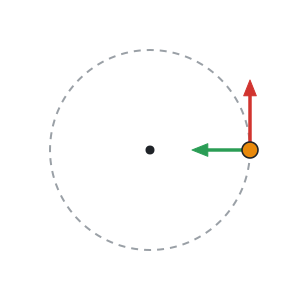
The green arrow is always perpendicular to the red one. The acceleration therefore has no component along the direction of travel or against it, and so the speed does not change. All the acceleration is used up turning the arrow. Why it points exactly to the centre and how large it is will be revealed by the diagram.
How large centripetal acceleration is
Let’s watch the point for just a short moment Δt. In that time it moves from point A to point B and covers a distance
The diagram shows this bit of motion twice. On the left you see the blue triangle of positions: the centre of the circle and the points A and B. Two of its sides are radii r, the third is the segment AB. Over a short moment the arc is almost straight, so the segment AB is practically Δs long. On the right you will find the green triangle of velocities: both velocity arrows drawn from one point and their difference
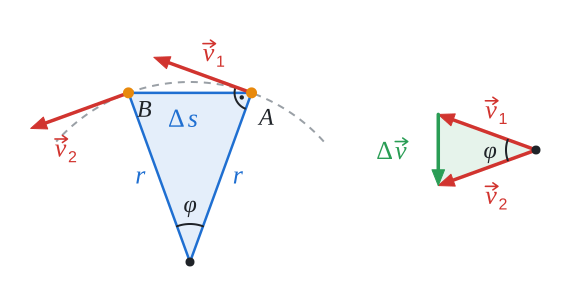
For clarity the angle is drawn large, but you should imagine it quite small. What matters is that both triangles have the same angle φ at the vertex. The velocity arrow is always perpendicular to the radius, so when the radius turns through an angle φ, the velocity arrow turns through the same angle. The radius and the arrow are joined like the arms of the letter L: turn one arm and the whole letter turns. Both triangles are isosceles with the same angle between the equal sides. They therefore have the same shape and differ only in size: they are similar. In similar triangles the ratio of the base to the equal side is the same:
In words: the green arrow is as many times shorter than the velocity arrow as the segment AB is shorter than the radius. We substitute v · Δt for Δs and rearrange the equation:
On the left-hand side is the change of velocity per unit of time, which is the acceleration:
We cheated a little, because the segment AB is a tiny bit shorter than the arc. But the shorter the moment we watch, the more the segment coincides with the arc, and for the instantaneous acceleration we take a moment so short that we cannot tell the difference. The formula is therefore exact.
The diagram also reveals the direction. The green arrow
The units work out too:
The formula also behaves sensibly. The faster the body moves, the longer the velocity arrow is and the faster it turns. Both increase the acceleration, which is why the speed is squared in the formula. As the radius grows, the circle straightens out and the acceleration falls. For a huge radius a piece of the circle is almost a straight line and the acceleration almost zero, exactly as it should be when travelling straight at a constant speed.
The second form of the formula follows when we replace the speed by v = ω · r:
This is an easy place to trip up. In the first form the radius is in the denominator, in the second in the numerator. Does the acceleration grow with the radius, or fall? Both are true, only each time something different is held constant. At the same speed, a wider bend is gentler and the acceleration is smaller. At the same angular velocity, on a merry-go-round for example, a horse at the edge has a greater speed, and so a greater acceleration, than a horse near the centre.
A quarter of a roundabout
Let’s go back to the roundabout. The car goes round it at 54 km/h, that is 15 m/s, and takes 3 s to get through a quarter of it. From the velocity arrow at the beginning and at the end of the quarter we get an average acceleration of about 7.1 m/s2 towards the centre. But what is the acceleration at each moment?
We need the radius. In 3 s the car travels 15 m/s · 3 s = 45 m and that is a quarter of the circumference of the circle:
Now it goes into the formula. We keep the radius as a fraction so that we don’t round in an intermediate result, and dividing by a fraction is multiplying by its reciprocal:
The instantaneous acceleration is 7.85 m/s2, more than the average of 7.1 m/s2. That is roughly as much as a car can manage in full braking on dry tarmac, so a roundabout this small is really sharp at 54 km/h. How come the numbers differ when the acceleration has the same magnitude the whole time? The average acceleration comes only from the first and last velocity arrows and their difference. Imagine all the velocity arrows from that quarter of the roundabout, drawn from one point. Their tips trace out a quarter of a circle of radius 15 m/s. The instantaneous acceleration tells us how fast the tip moves along this arc. The average acceleration works only with the straight line joining the first and last tips, and that is shorter than the arc. Displacement and distance differ in the same way: the straight route is always the shorter one.
We can check the numbers. The arc is a quarter of the circumference of a circle of radius 15 m/s, that is
The first number is the instantaneous acceleration from the formula, the second is the average. The shorter the stretch of roundabout, the more the arc and the line coincide, and the average acceleration approaches the instantaneous one.
A car in a bend
Now the car goes at the same 54 km/h round a wider bend of radius 50 m. What is its acceleration? We write down what we know and convert the speed straight to metres per second:
We substitute into the formula:
Compared with the roundabout the acceleration is almost halved; a wider bend is gentler. But watch the speed, which is squared in the formula. If the car enters the same bend twice as fast, its acceleration is four times greater, 18 m/s2, and no car on the road can manage that. That is why you brake before a bend and not in the middle of it. An acceleration of 4.5 m/s2 is not to be sneezed at; it is roughly like firm braking. It just points sideways.
The Earth around the Sun
The Earth circles the Sun at a speed of about 30 km/s, that is 3 · 104 m/s, at a distance of about 1.5 · 1011 m. We can check the speed: one revolution takes a year, about 3.16 · 107 s, so
The Earth’s path is not exactly a circle, but it is very close to one, so we can substitute into the formula:
That is only 0.006 m/s2. Every second the velocity arrow changes by a mere six millimetres per second, which is nothing against a speed of thirty kilometres per second. In one second the Earth travels 30 km and deviates from a straight line by only
Why a washing machine spins the water out of the washing
The drum of a washing machine with a radius of 0.25 m, spinning at 1,200 rev/min, turns at an angular velocity of 40π rad/s. Now the second form of the formula comes in handy:
The radian is a plain number, so what is left of the units is metres per second squared. This acceleration is over four hundred times greater than the acceleration due to gravity g, that is over 400g. If you want to check it from the speed of the drum wall, 31.4 m/s, and the formula
The angular velocity is squared in the formula. A washing machine that spins at only 800 rev/min turns a third slower, but its acceleration is less than half as large:
What does this mean for the washing? For a drop of water to go round with the drum, it has to keep turning, and with an enormous acceleration. The sock on the circle is held by the wall of the drum, but the wall has little holes in it. A drop that gets over a hole has nothing left to turn it. It stops turning and carries on in a straight line along the tangent, out of the drum. The sock stays inside and the water is outside. What exactly forces bodies to turn is a question of forces. Kinematics has told us how much acceleration such turning needs, and for a washing machine it really is a lot.
So we have described the motion, but not its cause. Why bodies start moving, brake and turn is explained by forces, and the second part of the category begins with them, in the article Force.
