
Weight and apparent weight
“I weigh 70 kilos,” says Oliver. Everybody knows what he means, and yet a physicist would raise an eyebrow. The kilogram is a unit of mass, not of force, and when Oliver stands on the scales, he presses on them with a force that is measured in newtons. At home on the floor this is just splitting hairs, but in a lift or on the Moon it is not.
Mass and weight
Mass m expresses how strongly an object resists a change in velocity. It is measured in kilograms and does not depend on where the object is. Oliver has a mass of 70 kg at home, on an aeroplane and on the Moon.
Weight
where g ≈ 9.81 m/s2 is the acceleration due to gravity. We can read the unit m/s2 as N/kg as well, because N = kg·m/s2. So the acceleration due to gravity also tells us that near the surface the Earth pulls every kilogram with a force of 9.81 N. An object with twice the mass is pulled by the Earth twice as hard.
For Oliver we get
On the Moon the acceleration due to gravity is only about 1.62 m/s2, roughly six times smaller. The Moon therefore pulls Oliver with a force of
His weight has fallen to a sixth, his mass stayed 70 kg. On the Moon Oliver could jump much higher, but if he wanted to get a loaded trolley moving or stop it, he would have to put in the same effort as at home. How much force a change of velocity requires is determined by the mass, according to Newton’s second law, and that has not changed. And kicking a boulder on the Moon would hurt just as much as it does here.
The normal force and apparent weight
Oliver is standing on the scales at home. The Earth pulls him down, yet he does not fall, because the scales push him upwards with the normal (contact) force
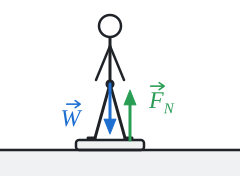
Where does the normal force come from? The floor and the platform of the scales both bend very slightly under Oliver, like a spring, and try to return to their original shape. The harder he presses on them, the more they bend and the more strongly they push back. The surface thus provides exactly as much force as is needed, though only up to a certain limit: thin ice on a pond or a rotten plank will not hold.
The normal force acts on Oliver. By Newton’s third law, Oliver pushes down on the scales with a force of the same size. The force with which an object presses on its support or pulls on a suspension is called its apparent weight. Weight and apparent weight are easy to mix up, because at rest they have the same magnitude and both point downwards. The difference is in what they act on:
- weight acts on the object, it is the Earth that pulls it,
- apparent weight acts on the support or the suspension, it is the object that presses on it or pulls on it.
A suspension works in the same way. A rucksack with a mass of 8 kg hanging on a hook has a weight of about 78 N, and the hook holds it up with a force of the same size. The rucksack, in turn, pulls the hook down with its apparent weight, also 78 N.
The apparent weight always has the same magnitude as the force that the support or suspension exerts on the object, because the two form an action–reaction pair. But it need not equal the weight, as we shall see in a moment.
Incidentally, we do not feel weight. It pulls equally on every bit of the body, the arms, the stomach and the head, and nothing can detect it. What we do feel is the floor or chair pushing us from below and the body being slightly compressed under that pressure. It is the normal force that corresponds to what we usually think of as the feeling of our own weight.
What the bathroom scales show
Bathroom scales contain a spring or a flexible metal strip that bends under load. So they measure the force with which you press on them, that is your apparent weight, and they are in fact a newton meter. But the display does not show newtons, it shows kilograms. The manufacturer assumed that you would stand on the scales at rest on Earth, where you press on them with a force of m · g. So the scales divide the measured force by the acceleration due to gravity:
So when Oliver says “I weigh 70 kilos”, he means his mass, and that really is 70 kg. To be physically precise, he would say that he has a mass of 70 kg and an apparent weight of 687 N. At home it comes out the same, because the scales convert one into the other with the same number every time.
If Oliver took the same scales to the Moon, he would press on them with a force of only 113 N. The scales would obediently divide by 9.81 m/s2 and show
Oliver has not lost a single gram, the scales simply assume that they are standing on Earth. It would therefore be wrong to say that his mass on the Moon is 11.6 kg. Only balance scales, which compare an object with a standard mass, would correctly determine the mass on the Moon, because the Moon pulls both pans equally weakly.
Scales in a lift
Oliver gets into a lift on the ground floor, stands on the scales and goes up. Two forces act on him: the weight downwards and the normal force of the scales upwards. We choose upwards as the positive direction, so the resultant force is FN − W and by Newton’s second law it equals m · a:
We add m · g and factorise out the mass:
The lift sets off with an acceleration of 2 m/s2 upwards. That is a really brisk lift: ordinary ones set off with roughly half that acceleration, so that passengers are not uncomfortable. We substitute:
The scales divide the force by 9.81 m/s2 and show about 84 kg. On the display, Oliver has put on 14 kilos. In reality the scales have to not only support him but also push him upwards, so they push harder. Oliver feels this stronger push in his legs as extra heaviness. His weight has not changed at all, the Earth still pulls him with a force of 687 N.
Once the lift is moving at a constant speed, the acceleration is zero and FN = m · g. The scales show 70 kg again, and Oliver with his eyes closed could not tell whether he was moving or standing still. We do not feel velocity, we feel only acceleration.
Just before the top floor the lift brakes. The velocity points upwards but decreases, so the acceleration points downwards, a = −2 m/s2:
The scales show about 56 kg and for a moment Oliver feels lighter.
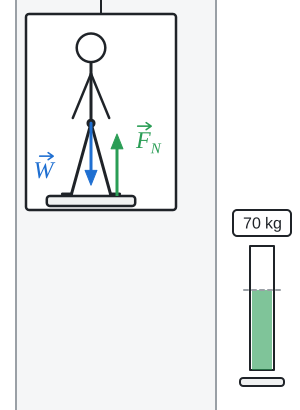
In the animation the lift stands still for a while, then sets off upwards, moves at a constant speed, brakes and stops. The blue weight stays the same length all the time. The green normal force and the green bar on the right, which shows the reading on the scales, get longer when the lift sets off and shorter when it brakes. The black arrow next to the cabin shows which way the acceleration points. The grey dashed line marks the reading at rest, and the display above the bar shows the reading in kilograms.
On the way down it is the other way round. When the lift sets off downwards, the acceleration points downwards and the scales show less; when it brakes before the ground floor, the acceleration points upwards and the scales show more. What matters is the direction of the acceleration, not the direction of travel:
| lift | acceleration | the scales show |
|---|---|---|
| setting off upwards | upwards | 84 kg |
| constant speed | zero | 70 kg |
| braking while going up | downwards | 56 kg |
| setting off downwards | downwards | 56 kg |
| braking while going down | upwards | 84 kg |
We can also work backwards. The scales in a lift show 77 kg, what is the acceleration of the lift? The scales measured a force FN = 77 kg · 9.81 m/s2. From the formula for the normal force we express the acceleration, divide the equation by the mass and subtract g:
The lift has an acceleration of about 0.98 m/s2 upwards. It is either setting off upwards or braking on the way down; the scales cannot tell the difference.
A falling lift and weightlessness
What if the cable snaps? A real lift would be stopped by safety brakes that grip the guide rails, but let’s think it through. The lift and Oliver are then falling with only their weight acting on them, just as in free fall, and have an acceleration g downwards, that is a = −g:
The scales show zero. Oliver and the scales fall in exactly the same way, Oliver does not press on them at all and they do not press on him. If he let go of his keys, they would hang in the air next to him, because they fall in the same way as he and the cabin do. This is called weightlessness. The apparent weight is zero, nothing presses on a support or pulls on a suspension.
But the weight is not zero. The Earth is still pulling Oliver with a force of 687 N, and that is exactly why he is falling. Weightlessness does not mean that gravity has disappeared, only that nothing balances it from below. Passengers on a special aeroplane can safely experience it; for about twenty seconds the plane flies so that its acceleration is exactly g downwards. The people inside float the whole time. You experience a weaker version of the same thing in a car that quickly drives over the crest of a hill. For a moment it has a downward acceleration, the seat pushes less and your stomach lurches.
g-force in terms of forces
The g-force tells us how many times more strongly the support pushes on us than when we are standing at rest. Now we can write it in terms of forces. It is the ratio of the normal force to the weight:
The mass cancelled, so the g-force does not depend on it. A heavy and a light passenger in the same lift experience the same g-force. When setting off upwards we get
that is a g-force of 1.2g. When braking it is 0.8g, at rest and at constant speed 1g, and in a falling lift 0g. So the g-force is the same thing as what the scales show, divided by what they would show at rest: 84 kg to 70 kg is again 1.2.
So far we have looked at what a force does when it acts continuously. What if it strikes for only a fraction of a second, for example in a collision or when kicking a ball? The next article looks at that: Momentum and impulse.
