
Physical quantities and units
“Harry travelled 5.” Five what? Five metres is the way to the fridge and back. Five kilometres is already a decent walk. Five thousand kilometres would be enough to drive from London to Lisbon and most of the way back. In physics a bare number says nothing, and it needs a unit:
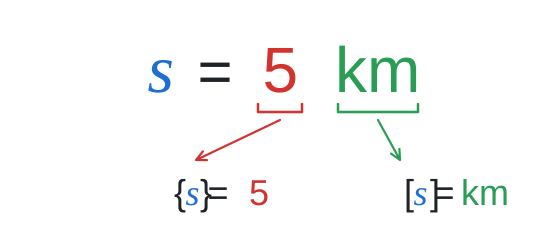
The notation has three parts. In blue is the symbol of the quantity, here s for distance. In red is the numerical value, 5, and in green the unit, the kilometre. The numerical value tells you how many times the unit fits into the quantity. Five kilometres is five times one kilometre:
Physics textbooks have a shorthand for both parts, which you can see at the bottom of the picture. Curly brackets around the symbol mean the numerical value and square brackets mean the unit: {s} = 5 and [s] = km.
Speed works in a similar way. The sentence “he travelled at a speed of 5” could mean 5 km/h, which is an ordinary walk, or 5 m/s, which is a brisk run. Without the unit you cannot tell whether Harry went for a stroll or was running for the bus.
What a physical quantity is
A physical quantity is a property that we can measure, that is, compare with a unit and express as a number. The length of a table, the time it takes to boil an egg, the mass of a bag of shopping and the temperature of the water in a pan are all quantities. Beauty, on the other hand, is not a quantity. There is no instrument that could measure it and no unit in which it could be given. The sentence “this photo has seven beauties” makes no sense.
Every quantity has a symbol, usually a single letter. Distance is s, time is t, mass is m and speed is v. The letters were not picked at random, they come from Latin: spatium is space, tempus is time, massa is mass and velocitas is speed.
The SI system
In the past every town measured in its own way. The Prague ell was about 59 cm and the Vienna ell almost 78 cm, and anyone who bought cloth in Prague and sold it in Vienna had to allow for the difference. Today almost the whole world uses one system, the International System of Units, SI (from the French Système international d’unités). It is based on seven base units:
| quantity | unit | unit symbol |
|---|---|---|
| length | metre | m |
| mass | kilogram | kg |
| time | second | s |
| electric current | ampere | A |
| thermodynamic temperature | kelvin | K |
| amount of substance | mole | mol |
| luminous intensity | candela | cd |
In kinematics and dynamics the first three are enough: the metre, the kilogram and the second.
How long is a metre? It was born in revolutionary France as one ten-millionth of the distance from the North Pole to the equator. Later a bar of platinum–iridium alloy was made to match it, and the metre was the distance between two marks on the bar. Today the metre is defined using light: it is the distance travelled by light in a vacuum in
The kilogram was originally the mass of one litre of water. For over a hundred years afterwards its size was set by a cylinder of platinum–iridium alloy, 39 mm tall and just as wide, kept in a vault near Paris. When it was compared with its precise copies, it turned out that they differ very slightly from one another. So since 2019 the kilogram has been defined by a constant of nature, and in principle it can be reproduced exactly in any laboratory with the right equipment, without comparing anything with the Paris cylinder.
For a long time the second was one 86,400th of a day, because a day has 24 · 60 · 60 = 86,400 seconds. But the Earth does not rotate perfectly regularly, so today the second is measured by atomic clocks.
Derived units
All other units are built from the base units. Speed is the distance travelled in a certain time, so we calculate it as distance divided by time:
If we measure distance in metres and time in seconds, we can divide their units in the same way as the quantities:
The unit of speed is the metre per second. Units like this are called derived units. They include the square metre m2 for area, the cubic metre m3 for volume and the metre per second squared m/s2 for acceleration. We will see what exactly is hidden behind that “second squared” when we come to acceleration.
Some derived units have their own name, mostly after a famous physicist. The unit of force is the newton N, named after Isaac Newton. For now it is enough to know that it can be expressed in base units:
We will explain why it is exactly this in the article on force.
The kilometre per hour, the minute, the hour, the litre and the tonne are not part of SI, but they may be used because they are well established in everyday life. In physics calculations, however, we usually convert them to base units first. We will show how to do that a little further on.
Powers of ten
In physics we often meet very large and very small numbers. The Sun is about 150,000,000 km from the Earth, which is 150,000,000,000 m. Writing and calculating with all those zeros is a nuisance, and it is easy to lose one. That is why such numbers are written using powers of ten.
The power 103 means that we multiply three tens together:
The exponent, the small number at the top, tells you how many zeros the result has. 106 is a one followed by six zeros, a million. When we decrease the exponent by one, we divide the result by ten. If we carry on below zero, we get
So a negative exponent does not mean a negative number, but a fraction:
Now we can write the distance to the Sun by putting a number between one and ten in front of the power of ten:
The Sun is about 1.5 · 1011 m from the Earth. We find the exponent from the number of places we must move the decimal point to turn 1.5 into 150,000,000,000. It is eleven places to the right.
With small numbers it works the other way round. A human hair is about 0.07 mm thick, which is 0.00007 m. To turn the seven into 0.00007 we must move the decimal point five places to the left, so the exponent is negative:
You can find more about calculating with powers in the article Powers and roots.
Unit prefixes
A power of ten can be replaced by a prefix in front of the unit. Kilo means a thousand, so a kilometre is a thousand metres and 3 · 103 m = 3 km. The most commonly used ones are summarised in the table:
| prefix | symbol | multiple | example |
|---|---|---|---|
| giga | G | 109 = 1,000,000,000 | GW |
| mega | M | 106 = 1,000,000 | MW |
| kilo | k | 103 = 1,000 | km, kg |
| deci | d | 10−1 = 0.1 | dm |
| centi | c | 10−2 = 0.01 | cm |
| milli | m | 10−3 = 0.001 | mm, mg |
| micro | µ | 10−6 = 0.000001 | µm |
A large nuclear power station has an output of roughly 2 GW, which is 2 · 109 W. A hair 7 · 10−5 m thick is the same as 70 µm, because 7 · 10−5 = 70 · 10−6.
The kilogram is an exception, as it already contains a prefix. Further prefixes are therefore added to the gram: a thousandth of a gram is a milligram, and nobody says microkilogram.
Watch out for capital and lower-case letters too. A small m is milli, a capital M is mega, and the difference between them is a factor of a billion. A laser pointer shines with a power of about 1 mW. If you write 1 MW instead, you have turned it into a wind turbine.
Converting units
You can convert units without remembering which way to multiply and which way to divide. All you need to do is treat the unit as a number, for which you substitute how much it is in the new unit. How many metres is 2.5 km? One kilometre is a thousand metres, so we substitute 1,000 m for the kilometre:
Time is converted in a similar way. How many hours is 45 min? A minute is a sixtieth of an hour:
And finally mass. A gram is a thousandth of a kilogram, so 350 g is
People often make mistakes with time. How much is 1.5 h? The answer that springs to mind is “one hour fifty”. But an hour has sixty minutes, not a hundred. Half an hour is
so 1.5 h is one hour and thirty minutes. The same holds the other way round: one hour twenty is not 1.2 h, but
Kilometres per hour and metres per second
The speedometer in a car shows kilometres per hour, but in physics we calculate in metres per second. We will convert as we did just now, treating the unit as a number. A kilometre is 1,000 m and an hour is 3,600 s:
We cancel the fraction
The whole rule follows from this: to go from km/h to m/s, divide by 3.6. A car travelling at 90 km/h is going at
Every second it covers 25 m. In the opposite direction, from m/s to km/h, we multiply by 3.6:
Why is one metre per second equal to 3.6 km/h? A metre is a thousandth of a kilometre and a second is
A typical slip is to mix up the direction and multiply where you should divide. Then the car appears to be going at 324 m/s, which is close to the speed of sound. It helps to realise that the metre per second is a larger unit than the kilometre per hour. For the same speed you therefore need fewer of them, and the number in m/s is always smaller than the number in km/h.
Here are two more examples to give you a better idea. A pedestrian walks at
so in a second they cover not quite a metre and a half. A car travelling at 130 km/h on a motorway abroad is going at
If you glance at your phone for two seconds at that speed, the car travels blind for more than 70 m.
Calculator
Enter a speed in kilometres per hour and the calculator will convert it to metres per second.
The same in the opposite direction, from metres per second to kilometres per hour:
Some quantities need more than a number with a unit, though: they also need a direction. How to calculate with them is shown in the next article, Scalars and vectors.
