
Uniform circular motion
A horse on a merry-go-round, the tip of a second hand, or a pebble stuck in the tread of a tyre (watched from the car) all move in a circle. If they keep up the same pace while doing so, we speak of uniform circular motion: the path is a circle and the speed does not change. In equal times the body covers arcs of equal length.
The direction of the velocity, on the other hand, changes all the time, because the arrow of the velocity always points along the tangent to the circle. The motion is uniform only in the magnitude of the velocity. How can we describe it with numbers?
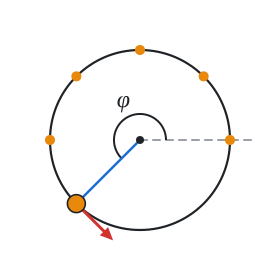
On a straight line one number was enough to fix the position, the position on the axis. On a circle one number is enough too: the angle through which the body has turned since the start. Angles will therefore accompany us at every step.
Period and frequency
A merry-go-round at a fair starts up and then keeps turning at the same steady pace. You stand next to it with a stopwatch and measure that your friend on the horse flashes past you every ten seconds. The time of one revolution is called the period; it is denoted T and measured in seconds:
We can also ask the opposite question: how many revolutions does the merry-go-round make in one second? That is the frequency f. If one revolution takes ten seconds, in one second the merry-go-round completes a tenth of a revolution. In general we find the frequency as one revolution divided by the period:
Substituting:
The unit “per second”, that is
The second hand goes round the clock face in a minute, so its period is T = 60 s and its frequency is
Engine and washing machine speeds are given in revolutions per minute. A washing machine spinning at 1,200 rev/min turns its drum twelve hundred times a minute. A minute has sixty seconds, so per second that is
A revolution is a mere count, so revolutions per second and hertz are the same thing. One revolution of the drum lasts
five hundredths of a second. No wonder you see the washing through the window only as a blur.
Angle measured by an arc
In some time the merry-go-round turns through a certain angle. We know how to measure it in degrees: a quarter of a revolution is 90°, a whole revolution 360°. But physics prefers to measure angles in radians, and we will see why straight away.
Imagine an angle with its vertex at the centre of a circle. Its arms cut off an arc of length s on the circle. On a larger circle the arc for the same angle is longer, by exactly as many times as the radius is larger: a circle twice as large gives an arc twice as long. The ratio of the arc length to the radius therefore does not depend on the size of the circle, only on the angle. It is precisely this ratio that gives the size of the angle in radians:
The angle through which a body turns on a circle is called the angular displacement and we denote it by the Greek letter φ (phi). One radian is the angle whose arc is as long as the radius. A number of radians therefore tells you how many radii fit into the arc.
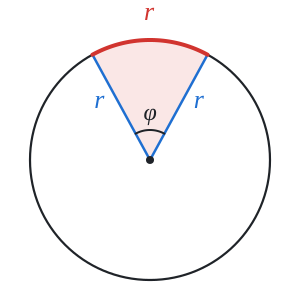
And how many radians is a whole revolution? The arc is then the whole circumference of the circle, that is 2π · r:
The radius cancelled, as we expected. A whole revolution is 2π radians, roughly 6.28:
Half a revolution is π rad = 180°, a quarter of a revolution is
Let’s see what happened to the units. The arc length and the radius are both in metres, and when we divide, the metres cancel,
Back to the merry-go-round. The inner horse, 2 m from the centre, moves 3 m along its arc. Through what angle has it turned? We substitute the arc and the radius into the formula:
The radius fits into the arc one and a half times. In degrees that is 1.5 · 57.3° ≈ 86°, almost a quarter of a revolution.
Why not degrees? The number 360 is a convention inherited from the ancient Babylonians, whereas the radian comes straight from the circle. Thanks to that, the arc length is very simple to work out, s = φ · r. With degrees the fraction
Angular velocity
The pace at which the merry-go-round turns is expressed by the angular velocity ω (omega). It is the angle through which the body turns per unit of time:
We measure the angle in radians and the time in seconds, so angular velocity is measured in rad/s. In uniform circular motion the body turns through equal angles in equal times, so the angular velocity is constant.
In one period the merry-go-round turns through a whole revolution, 2π radians. Therefore
We can put the period of our merry-go-round into the formula:
Every second the merry-go-round turns through a little more than half a radian, that is about 36°. With a period of 60 s the second hand is six times slower,
It is easy to mix up frequency and angular velocity, so be careful. Both describe how fast the merry-go-round turns, only in different units: frequency in revolutions per second, angular velocity in radians per second. One revolution has 2π radians, and so the angular velocity is always a number 2π times larger than the frequency. If you forget the 2π, you get 0.1 rad/s instead of 0.63 rad/s for the merry-go-round. The radian is a plain number, so rad/s and Hz are both just “per second” once the radian is cancelled. Even so, we do not write angular velocity in hertz, precisely so that nobody confuses it with frequency.
With constant angular velocity the angle works out just like the distance in uniform motion in a straight line, only with angular velocity instead of speed and angle instead of distance. Multiplying
that is a quarter of a revolution. A quarter of the period does last exactly 2.5 s.
What matters about angular velocity is that it is shared by the whole merry-go-round. The horse at the edge and the horse near the centre both go round once in the same ten seconds, turning through the same angle every second.
Why the edge moves faster
Two horses ride side by side on the merry-go-round, the inner one 2 m from the centre and the outer one 4 m from the centre. They ride together as if on one pole, so in the same time they sweep out the same angle. But the outer horse travels on a larger circle, so in the same time it covers an arc twice as long. Both make the same number of laps during the ride, but the outer horse’s lap is twice as long. The animation shows it: the spoke carrying both horses turns as a whole, they share the angle, and yet the red track grows twice as fast as the blue one.
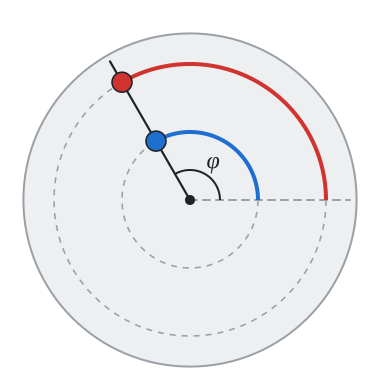
Twice the distance in the same time means twice the speed. Let’s work it out. In one revolution the horse covers the whole circumference of its circle, 2π · r, and it takes one period T. Speed is distance divided by time:
Careful: r is the distance from the centre, the radius of the circle the horse travels on, and not the diameter of the whole merry-go-round. For the outer horse we substitute 4 m:
That is roughly 9 km/h, a decent jog. The inner horse:
That is about 4.5 km/h, an ordinary walk. Anyone standing exactly at the centre turns on the spot and goes nowhere. That is why children fight over the horses at the edge, and the wind blows harder there too. Anyone who sits near the centre is really riding a pony.
We can also arrive at the speed from the angular velocity. Speed is distance per time,
The fraction
The speed v is specifically called the linear speed (or tangential speed), so that it is not confused with the angular velocity. For a given angular velocity it is directly proportional to the distance from the centre. We check this on the outer horse:
It matches. For the inner horse we get
The formula also works the other way. The owner of the merry-go-round wants the outer horse to travel at 3 m/s. How fast must the merry-go-round turn? From the relation v = ω · r we divide both sides by the radius:
We get the period from the relation
One revolution of the merry-go-round must therefore take about eight and a half seconds instead of ten. The inner horse will then travel at half that speed, 1.5 m/s.
For the opposite extreme we turn to clocks. The tip of a minute hand 10 cm long goes round with a period of 3,600 s, so
That is about a sixth of a millimetre per second, so a snail would overtake it. We therefore cannot see the hand move with the naked eye, but after five minutes we can see that it has moved.
Finally we return to the washing machine. The drum has a radius of about 25 cm, that is 0.25 m, and an angular velocity of 40π rad/s:
That is about 113 km/h. A sock pressed against the wall of the drum during the spin hurtles along at the speed of a car on a motorway, even though the washing machine stays put in the bathroom.
The horse on the merry-go-round and the sock in the drum keep going at the same speed, and yet their velocity arrow points somewhere different at every moment. Why such motion is accelerated, where that acceleration points and how large it is, is explained in the next article, Centripetal acceleration.
