
Scalars and vectors
“It’s 20 °C outside.” There is no need to add anything else, because everybody knows whether to take a jacket. A number and a unit are enough to describe the temperature. But try giving someone directions with the sentence “go 100 m”. They will ask at once: where to? Straight on, left, back? A hundred metres north will take them to the station, a hundred metres south straight into the pond. For a quantity like this a number is not enough, we also need a direction.
Scalar or vector?
Quantities that are fully described by a number with a unit are called scalars. Temperature, time, mass and distance are scalars. When you say that a bag has a mass of 5 kg or that a film lasts 2 h, you do not need to add anything. Mass does not point left or up.
Quantities for which direction matters as well are called vectors. A typical vector is force. Anyone who has ever moved a wardrobe knows that pushing it towards the wall is something different from pushing it away from the wall. Velocity is a vector too: a car travelling at 90 km/h towards Nottingham and a car travelling at 90 km/h away from it have the same speed, and yet each is going somewhere else.
We recognise a vector by the arrow above the symbol. Force as a vector is written
The magnitude of a force is a scalar, for example F = 300 N. The newton N is the unit of force, and we will not need to know more about it for now. Here force mainly serves as an example of a vector.
A vector as an arrow
We draw a vector as an arrow. It points in the direction of the vector and its length corresponds to the magnitude. To be able to draw the arrow we choose a scale, for example that one centimetre on the paper stands for 100 N. A force of 300 N is then an arrow three centimetres long, and a force of 50 N an arrow only half a centimetre long.
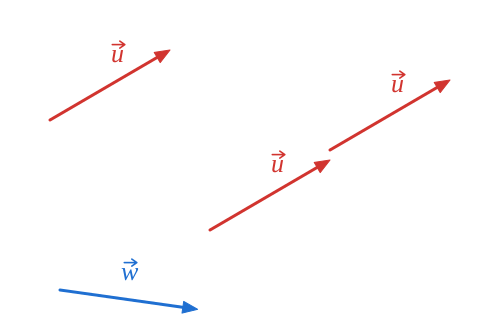
In the picture we see three red arrows. They all have the same length and direction, so they represent one and the same vector
The blue arrow
Adding vectors
Harry sets off from a cottage and walks 3 km east. Then he turns and walks another 4 km north. How far from the cottage is he?
Let’s draw it. In the picture north is at the top, east is on the right and one square measures a kilometre. The orange dot is the cottage, the red arrow is the first stretch and the blue arrow the second.
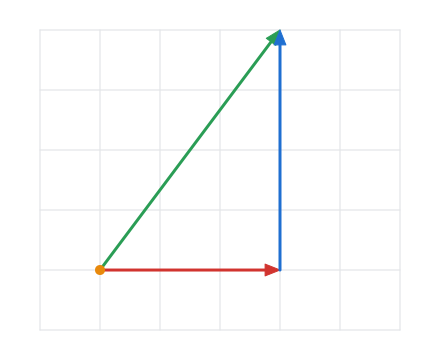
The blue arrow does not start at the cottage but at the end of the red one. After all, Harry walked north from the place he had reached by going east. This is how vectors are added: we move the second arrow so that it starts at the end of the first. The sum is then the arrow that leads from the start of the first arrow to the end of the second. In the picture it is green, and it shows where Harry ended up. The animation shows it step by step: the blue arrow first starts from the same place as the red one, then moves to its end, and only then does the green one appear.
If we add ordinary numbers instead of vectors, we get 3 km + 4 km = 7 km. Harry really did walk seven kilometres, but he is not that far from the cottage. He took a detour, the green arrow is a shortcut, and that is why it is shorter than both stretches together.
How long is the green arrow? The red, blue and green arrows together form a right-angled triangle, that is, a triangle with one right angle. The two sides that form the right angle are called the legs, and the third one, the longest, opposite the right angle, is the hypotenuse. Pythagoras’ theorem holds for a right-angled triangle: the square of the hypotenuse is equal to the sum of the squares of the legs. The legs measure 3 km and 4 km, so for the hypotenuse c we have
Let’s square. The unit is squared as well, a kilometre times a kilometre is a square kilometre:
And take the square root:
Harry is 5 km from the cottage. In physics the arrow leading from the place where we started to the place where we finished is called the displacement. Unlike the kilometres walked, it is a vector: besides the five kilometres it also tells us in which direction the cottage lies. We will come back to the direction at the end of the article.
We can write the sum just as we do with numbers, only with arrows. When we add two vectors
whereas the sum of the magnitudes is
The parallelogram rule
A dog walker has two dogs on leads. Each pulls in a different direction, one with force
The forces act at the same point, so the most natural way is to draw the arrows from a common starting point. We find the resultant force with the parallelogram rule. From the end of each arrow we draw a dashed line parallel to the other one. This creates a parallelogram, and its diagonal starting at the common point is the sum we are looking for,
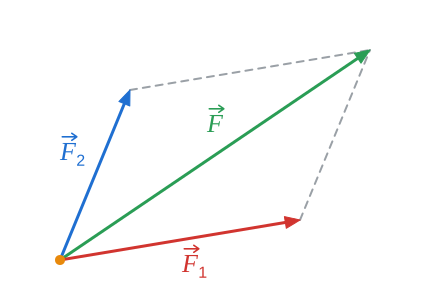
Why does it work? The right-hand dashed side of the parallelogram is as long as the blue arrow and parallel to it. So it is the blue arrow
The green arrow shows where the dogs pull the walker. It is often called simply the resultant. Because each dog pulls a little differently, the resultant force is smaller than if both pulled in the same direction. We can measure its magnitude in the picture using the scale. For now we can calculate it only in two cases: when the forces are perpendicular to each other, like Harry’s two stretches, or when they lie on one line (that comes right below).
Vectors on one line
Calculation is easiest when the vectors lie on one line. Two friends are pushing a broken-down car. One pushes with a force of 300 N, the other with 250 N, both forwards. We place the arrows one after another and get an arrow whose length is simply the sum:
The red and blue arrows are the forces of the two friends, the green one is the resultant force.

A different situation: a game of tug of war. One team pulls to the right with a force of 300 N, the other to the left with 250 N. Both forces act on the knot in the middle of the rope and point exactly against each other. The arrows start at the knot and go in opposite directions, and that is why the resultant force is the difference:

In the picture the force of the first team is red, the second team’s is blue and the resultant force is green. The resultant force of 50 N points to the right, towards the stronger team. If both teams pulled equally hard, the resultant force would be zero and the forces would balance. Only when vectors point in the same or in exactly opposite directions do their magnitudes add and subtract like ordinary numbers.
The opposite vector and multiplying by a number
A vector that has the same magnitude as
This is how a tug of war between two equally strong teams ends. The opposite vector also lets us subtract: to subtract
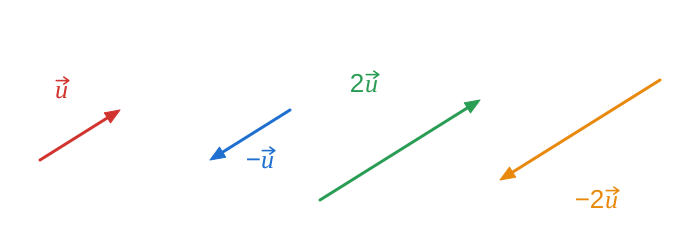
We can also multiply a vector by a number. The green vector
In physics this means: if we double a force and let it act in the same direction, we get the force
Sine and cosine
It often pays to resolve a slanting vector into two perpendicular ones, for example a horizontal one and a vertical one. For that we have to introduce two new concepts, sine and cosine. Both come from the right-angled triangle.
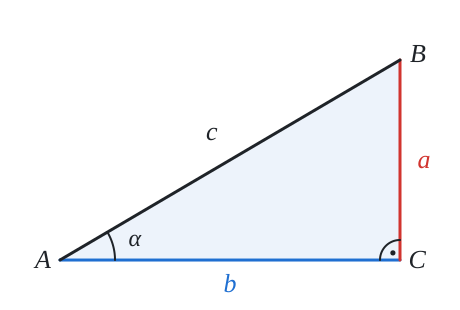
The triangle in the picture has a right angle at vertex C, and the hypotenuse is the black side c. Let’s look at the angle α at vertex A. The red leg a lies opposite it, which is why it is called the opposite side. The blue leg b forms the angle α together with the hypotenuse, and it is called the adjacent side.
The sine of the angle α is the ratio of the opposite side to the hypotenuse, and the cosine is the ratio of the adjacent side to the hypotenuse:
What is such a ratio good for? Enlarge the whole triangle to twice the size. All the sides will be twice as long, but the angles stay the same. The ratio
The hypotenuse is the longest side of a right-angled triangle, so both ratios always come out smaller than one. The sine or cosine of an acute angle never exceeds one.
The sine and cosine of any angle can be found with a calculator, which has sin and cos buttons. But make sure the calculator is working in degrees. If you do not see DEG on the display but RAD or GRAD, it is working in other angle units and you will get nonsense. It is one of the most common mistakes in tests. You can find more about both functions in the article Sine and cosine.
Three angles without a calculator
For the angles 30°, 45° and 60° we can work out the sine and cosine even without a calculator. An equilateral triangle and a square are all we need.
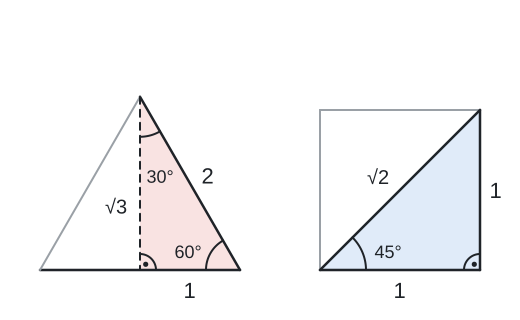
On the left we see an equilateral triangle with side 2. All its angles are 60°. The dashed height divides it into two congruent right-angled triangles. The red one has hypotenuse 2, bottom leg 1, because that is half of the side, and angles of 60° at the bottom and 30° at the top, because the height bisects the top angle. We find the length of the height from Pythagoras’ theorem:
For the angle 60° it is the other way round, the height
On the right is a square with side 1, divided by a diagonal. The diagonal bisects the right angle, so the blue triangle has an angle of 45°, both legs of length 1 and a hypotenuse of
All together:
| angle | sine | cosine |
|---|---|---|
| 30° | ||
| 45° | ||
| 60° |
It is interesting that the sine of 30° is the cosine of 60° and vice versa. This is no coincidence: the opposite leg of one acute angle is the adjacent leg of the other.
Resolving a vector into components
Joe is pulling his little sister on a sledge. He holds the rope in his hand, so it does not run horizontally but slants upwards, making an angle of 30° with the ground. He pulls it with a force of 100 N. But the sledge moves along the ground, not slantwise into the air. How much of that force really goes forwards?
We replace the slanting force
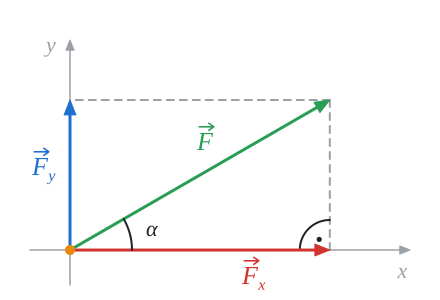
The picture shows the green force
The red component, the right-hand dashed side and the green force form a right-angled triangle. The hypotenuse is the force
We multiply both equations by the magnitude of the force F and get formulae for the magnitudes of the components:
We substitute Joe’s values. The horizontal component is
and the vertical one
Only about 86.6 N out of a hundred pulls the sledge forwards. The remaining vertical component of 50 N lifts the sledge slightly, so it presses on the snow less.
Notice that 86.6 N + 50 N gives more than 100 N. This is not a mistake, the components are vectors and they do not add like numbers. Only arrows can be added, one after another, and they give back the original 100 N.
And what if Joe lifts the rope higher, to 60°? Then
He would pull forwards with only half the force. The steeper the rope, the smaller the part of the force that goes forwards and the more it lifts the sledge.
Combining components again
So far we have been resolving a force. Often the opposite is needed: we know two perpendicular components and want the whole vector. The components are the legs of a right-angled triangle and the vector is its hypotenuse, so we calculate the magnitude with Pythagoras’ theorem:
Let’s check it on the sledge. We substitute the components:
Square:
And take the square root:
We got the original force. The tiny deviation under the square root arose because we rounded the cosine to 0.866.
Now we can return to Harry and his walk. His displacement has components of 3 km east and 4 km north, and we already know the magnitude, 5 km. What remains is the direction. Let α be the angle that the green arrow makes with the red one, that is, with the eastward direction. The northward component of 4 km lies opposite it and the hypotenuse measures 5 km:
The kilometres cancelled, so the sine is an ordinary number without a unit. The angle whose sine is 0.8 can be found on a calculator with the sin−1 button (usually above the sin button):
Harry’s displacement is therefore 5 km in a direction that turns 53° from east towards north. A magnitude and a direction are all a vector needs. If Harry wanted to return by the shortest route, he would follow the opposite vector: 5 km in the opposite direction, that is, to the south-west, somewhat more south than west.
Displacement will stay with us throughout kinematics. In the next article, Motion and rest, we will set it against distance and show why a runner who has completed a full lap of the field has not actually been displaced anywhere.
